
Bicycle Accidents Involving Children: What Parents Should Know

It is often a rite of passage for a New Jersey child to learn how to ride a bicycle because it gives them new freedom to explore the world around them.  Most of us remember the first time our parents or siblings detached the training wheels and let go of the seat, launching us to explore our neighborhoods. Though we may have learned how to balance and ride a bike, we were not fully trained in bike rider safety. Instead, good parents trust other drivers to drive responsibly and watch out for children. Unfortunately, too often children are accident victims suffering serious injuries or worse. And oftentimes, the police report blames the child for the accident. The good news is that the police report is not evidence, and the police officer’s opinion is usually excluded as well.

While bike riding is great exercise and fun for kids, it also comes with real risks. Every year, thousands of children are seriously hurt in bicycle accidents, and many with cars. The Centers for Disease Control and Prevention report that more than 100 children go to the emergency room every day because of bicycle-related injuries. Children under 14 make up more than 20% of all bicycle-related deaths in the United States. That’s a statistic no parent wants to hear, but also shouldn’t be ignored.

What’s Different About Bicycle Accidents Involving Children?

When a driver is distracted, speeding, or just not paying attention, it can have devastating consequences. Most bicycle accidents happen in common areas, for example, while backing out of a driveway or at a crosswalk. Even in quiet, residential areas, accidents happen too often. In many of these cases, the driver can be held responsible for not taking proper care to avoid the child.

Children don’t always see danger the way adults do. They may not understand traffic laws and assume drivers will stop for them, even though this is not the case. The law recognizes that kids don’t have the same reaction time or judgment as adults, so drivers are expected to be more careful when children are nearby, especially at parks, in local neighborhoods, or near schools.

Sometimes the fault of the accident isn’t only on the driver. If the road is in bad condition, a sidewalk is broken, or signs are missing, the city or property owner could also be held responsible. Having an experienced New Jersey bicycle accident lawyer who knows how to investigate all the details of the crash and build a strong case will help you navigate all of the legal possibilities to get the justice you deserve.

If a child is injured by a driver of an automobile, their medical bills will be paid by their household automobile insurance policy under the terms of their family members’ Personal Injury Protection (PIP) coverage.  This is because New Jersey is a No-Fault Insurance State.  The bike rider may also benefit from the household’s auto insurance policy that will provide Uninsured Motorist Coverage as well as Underinsured Motorist coverage.

Injuries After a Child Bicycle Crash

Children are still growing, so injuries can have a more serious and lasting impact than they would for adults. Many children involved in accidents suffer broken bones, head injuries, or damage to their spine or internal organs. Even when wearing a helmet, head trauma and other injuries can happen and sometimes lead to long-term effects.

Some of the most common injuries in child bicycle crashes include:

  • Concussion, head injuries, and traumatic brain injuries (TBI)
  • Broken bones and fractures affecting growth plates
  • Dental injuries
  • Neck, back, and spinal injuries
  • Internal bleeding
  • Scars, lacerations
  • Emotional injuries and PTSD

The road to recovery can be long and expensive. Some injuries require surgeries, physical therapy, and follow-up care for years. Getting financial help through a legal claim can help support you through recovery, cover medical bills, physical therapy, special equipment, and emotional suffering. It can also make sure your child has what they need moving forward.

Do I Need a Bicycle Accident Attorney?

When a child is injured in a bicycle accident, every detail matters. The damage caused in these accidents is not only medical, but also emotional suffering, lost opportunities, and lifelong care the child’s injuries could require. Families in these situations are under stress and may not be thinking about what their long-term options are while they are focusing on their child’s recovery.

That’s why it’s so important to work with a law firm that has experience in child injury and bicycle accident cases. At Davis, Saperstein & Salomon, we’ve been representing injured children and their families in New Jersey and New York for more than 40 years. We understand how upsetting and confusing these cases can be, and we are here to support and fight for you. We work with doctors, accident investigators, and other professionals to build the strongest case possible and secure the justice you deserve.  We accept these cases on a contingent fee basis, which means there is no legal fee unless a case is won, which is based upon a percentage of the final settlement.  In New Jersey, the legal percentage charged to a minor by personal injury lawyers is 25%.

Child Bicycle Accident? Call Today.

When a child is injured in a bike crash, the questions that follow are overwhelming. Who is at fault? Who will pay the medical bills? What are your rights? You don’t have to go through it alone; having an experienced personal injury lawyer is incredibly important to help support you and your family during this time. At Davis, Saperstein & Salomon, P.C., we help parents understand their legal options, hold the right people accountable, and fight for the support children need to recover.

Let our experienced legal team help you take the next steps to receive the compensation deserved for pain and suffering. We’ll walk you through your options, explain everything in simple terms, and give your case the attention it deserves. Call us today for a free, no-obligation consultation. Together, we can work for justice and support your child’s needs for a better tomorrow.

Clients seeking experienced personal injury lawyers in Teaneck, NJ, or the surrounding Bergen County area can contact Davis, Saperstein & Salomon, P.C. at 1-800-LAW-2000 or via email at info@dsslaw.com. Our firm offers free, no-obligation consultations and second opinions, and has offices throughout New Jersey and New York City.


The post Bicycle Accidents Involving Children: What Parents Should Know appeared first on Davis, Saperstein & Salomon, P.C..

from Davis, Saperstein & Salomon, P.C. https://www.dsslaw.com/blog/bicycle-accidents-involving-children-what-parents-should-know/
via https://www.dsslaw.com/
Protecting our Protectors: Police Officer Rights when Injured on the Job

Some run away from danger, but others bravely run towards it. Those heroes usually are our police and other first responders. Being a police officer or firefighter in New Jersey is a demanding and dangerous job. Though well-trained in rescue and safety, they are often injured on the job.  But what are their rights?  Simply put, they have the same rights as other workers injured during their employment, however, there are some wrinkles unique to law enforcement and other public servants.

A perfect example of this was on May 15, 2025, on Farview Avenue in Paramus, NJ, when a Paramus Emergency Services Unit police officer was injured in the line of duty.  It was reported that the officer was dispatched to escort a woman giving birth who was on Route 17 in Paramus to a hospital when his vehicle collided with a dump truck.  The dump truck driver was ejected from his vehicle. Both drivers were taken to Hackensack Meridian Hospital, where they were treated and released. The cause of the accident remains under investigation.  However, regardless of who caused the collision, the law enforcement officer has the right to make a workers’ compensation claim.

In New Jersey, when a police officer is injured on the job, the officer must file a workers’ compensation claim for the officer’s medical treatment, wage continuation, and benefits, including a possible permanency settlement for the officer’s permanent injuries. The officer is entitled to these benefits even if they caused their own injury because of a fall or automobile accident.

The officer may also have a right to sue the wrongdoer, but that can be a bit more complicated because police officers, like anyone else, still must prove fault on the part of the wrongdoer.  These cases against a wrongdoer or negligent driver who crashed into a cop car are known as a third-party claim. This allows an officer to recover damages for all the above and future economic losses.  Here are some ways police officers are injured:

When injured, it is important that a police officer immediately report their injury to their supervising officer, who will then report the incident to their supervising officers.  The injured police officer should consult with a qualified New Jersey Workers’ Compensation Lawyer who is experienced in representing police officers, firefighters, and other public servants, including DPW workers.

The New Jersey law firm of Davis, Saperstein & Salomon, P.C. has represented public servants for over 40 years.  Our Workers’ Compensation Department is headed by attorney Steven H. Cohen, an expert in New Jersey Workers’ Compensation Claims.  His team will process your claim through the police department’s workers’ compensation insurance carrier and assist you in getting the proper medical care you need to heal from your injuries.  Sadly, too many of these injuries are permanent or career-ending.  Under such circumstances, Mr. Cohen and the Workers’ Compensation Department of Davis, Saperstein & Salomon, P.C. will assist you in handling your claim for benefits and potentially secure a permanency award for your injuries.  Our Workers’ Compensation Department will also investigate and work with the 25 qualified Davis, Saperstein & Salomon, P.C. attorneys to potentially pursue your Third-Party Claim rights.  We have represented police officers in Bergen, Hudson, Passaic, Union, Essex, and Middlesex Counties, including State Police Officers, Correctional Institutional Officers, Port Authority Police Officers, Local law enforcement, and County and Sheriff’s Officers.

Steven H. Cohen is also the author of a consumer’s guide to New Jersey Workers’ Compensation Claims, which can be downloaded free at Getting the Benefits You Deserve – Workers’ Compensation Claim.

Some of the common injuries suffered by law enforcement officers and firefighters include:

  • Injuries to the shoulders, including torn ligaments and rotator cuff tears
  • Fractures of legs, arms, wrists, and fingers
  • Knee injuries, including torn meniscus, ACL tears, and fractures
  • Leg and ankle injuries requiring surgery
  • Eye and Ear injuries from firearms
  • Lacerations, bruises, and scars from altercations
  • Concussions and brain injuries
  • Automobile-related injuries from collisions
  • Work-related depression, anxiety, and PTSD
  • Unfortunately, self-inflicted wounds and death by suicide.

Too often, an injury to a shoulder, elbow, or wrist of a shooting arm will end a police officer’s career. Any injuries could affect their ability to fulfill other duties, affecting their promotion and advancement within the department.

To learn your rights, call Davis, Saperstein & Salomon, P.C., and ask to speak to Partner Steven H. Cohen for a free, no-obligation, confidential consultation to understand the law and learn your rights. All consultations are free, and you will not pay anything unless your case is won and settled.  Never settle for less. Call (201) 444-4444 to get started.

The post Protecting our Protectors: Police Officer Rights when Injured on the Job appeared first on Davis, Saperstein & Salomon, P.C..

from Davis, Saperstein & Salomon, P.C. https://www.dsslaw.com/blog/protecting-our-protectors-police-officer-rights-when-injured-on-the-job/
via https://www.dsslaw.com/

New Jersey Car Accident Laws in a Nutshell – What Every NJ Driver Needs to Know

Car accidents are stressful, confusing, and often life-changing, and most drivers, after being involved in a crash, are not sure what to do or what their legal rights are. That’s why every NJ driver needs to have a basic understanding of New Jersey’s auto insurance laws and how they affect you if you are involved in an automobile collision.  So, here’s what you need to know in a nutshell.

  1. New Jersey Is a No-Fault State

New Jersey has a “no-fault” insurance system, called Personal Injury Protection (PIP), which means your own household’s auto insurance policies pay for your medical bills up to the amount of your PIP coverage, no matter who caused the car accident.  Even if you do not own a car, your PIP benefits will be paid by the nearest blood relative of your living within your household and that should not affect their insurance costs.

  1. Report on the Accident

If you did not cause the collision, it is always best to call the police to the accident scene.  In New Jersey, any accident that causes injury, death, or property damage over $500 must be reported to the police within 10 days after the collision. If you don’t report an accident, it can lead to penalties or even a suspended license.

  1. What If You’re Partially at Fault?

New Jersey uses a comparative negligence rule. This means that if you’re found to be partially at fault for the accident, your compensation can be reduced by your percentage of fault. For example, if you were 20% at fault and your damages totaled $100,000, you could still recover $80,000. If you are found to be more than 50% at fault, you will not be able to be paid for your injuries or financial losses.

  1. Strict Statute of Limitations

In New Jersey, you have a limited time to file a car accident lawsuit, which is called the statute of limitations. If you miss this deadline, you may lose your right to seek compensation or legal action altogether.

  • 2 years from the date of the accident to file a personal injury claim
  • 6 years to file for property damage
  • 90 notice to public entities
  • Up to age 20 for an injury to a minor
  1. You Can Choose Limited or Unlimited Right to Sue

When buying car insurance in New Jersey, you’ll be asked to choose between a limited right to use or an unlimited right to sue. This choice can greatly affect your legal options after a crash, so review your insurance contract carefully before choosing to make sure you fully understand the policy.

The basic principles are:

  • Limited Right to Sue:  Also called Limited Tort and Verbal Threshold
  • Lower premiums, but fewer options to sue for pain and suffering, unless the injuries are permanent injuries to a body part.
  • Unlimited Right to Sue: Higher premiums, but you can sue for pain and suffering regardless of injury severity.  Also known as No Threshold or Zero Threshold.
  • Commercial Vehicle Exception:  If injured by a commercial vehicle such as a truck, bus, or tractor-trailer, you automatically have no threshold and you sue for both temporary and permanent injuries.
  1. What Damages Can You Recover in a Lawsuit?

If your injuries meet the legal threshold to sue, you may be entitled to recover damages for:

  • Medical bills (past and future)
  • Lost wages and reduced earning capacity
  • Pain and suffering
  • Emotional distress
  • Property damage
  • Any out-of-pocket expenses
  • Losses to your spouse

An experienced personal injury attorney can help estimate the full value of your claim, fight for your right to compensation including pain and suffering, and help guide and support you through the complex legal process.

Hire an Experienced New Jersey Personal Injury Lawyer

Navigating New Jersey car accident laws and insurance claims on your own is tough. That’s why having an experienced personal injury attorney in your corner makes all the difference with your case.

At Davis, Saperstein & Salomon, P.C., we’ve been standing up for accident victims across New Jersey for over 40 years. We’ve secured over $1 billion in verdicts and settlements and helped over 35,000 clients and their families. Our award-winning legal team knows how to fight for your rights to get the compensation you deserve.

Get a Free Book about New Jersey Personal Injury Claims:

Davis, Saperstein & Salomon P.C. Partners Garry R. Salomon and Jeffrey E. Salomon co-authored the second edition of The Consumer’s Guide to New Jersey Personal Injury Claims (2nd edition 2024) available at amazon.com or by calling 1-800-529-2000.

Injured in a Car Accident? We’re Here for You.

If you or someone you love has been injured in a car accident, don’t wait! Whether you have been injured in a car accident, slip and fall, a fire, or require representation for a claim, the personal injury attorneys at Davis, Saperstein & Salomon, P.C. offer compassionate, skilled legal representation to ensure you receive the compensation you deserve.

Clients seeking experienced personal injury lawyers in Teaneck, NJ, or the surrounding Bergen County area can contact Davis, Saperstein & Salomon, P.C. at 1-800-LAW-2000 or via email lawinfo@dsslaw.com. Our firm offers free, no-obligation consultations and second opinions, and has offices throughout New Jersey and New York City.

The post New Jersey Car Accident Laws in a Nutshell – What Every NJ Driver Needs to Know appeared first on Davis, Saperstein & Salomon, P.C..

from Davis, Saperstein & Salomon, P.C. https://www.dsslaw.com/blog/new-jersey-car-accident-laws-in-a-nutshell/
via https://www.dsslaw.com/

Can I Still File a Claim If I Wasn’t Wearing a Helmet in a Bike Accident?

Biking offers freedom and a break from traffic, but when there’s an accident with a car, truck, or bus, the injuries can be quite severe, especially if it involves a mild traumatic brain injury. If you’ve been hurt in a bike crash and were not wearing a helmet, you may be wondering: Can I still file a personal injury claim?

The short answer is yes. In most cases, you can still sue the negligent driver and get monetary damages as compensation. However, not wearing one could affect your case and the amount of money you actually receive. At Davis, Saperstein & Salomon, P.C., our bicycle accident attorneys help injured riders understand their rights and fight to win them the full compensation they deserve—helmet or not.

Understanding Bicycle Helmet Laws in New Jersey

In New Jersey, bicycle helmet laws are kept simple. Anyone under 17 years old is required by law to wear a helmet while riding a bike (this also applies to roller skates, skateboards, and scooters). On the other hand, adults are strongly recommended to wear a helmet, but it’s not required by law.

Can Not Wearing a Helmet Hurt My Personal Injury Case?

Even though adults can ride their bicycles without a helmet, insurance companies and their defense lawyers can argue that because you consciously decided not to wear a helmet, and if you did, your injuries would not have been as serious, neglecting your safety. This is known as comparative negligence, and it can reduce the jury award or settlement money you receive if you’re found even partly responsible for your injuries.  Obviously, this does not apply to leg, arm, and other fractures.

In reality, most bike accidents are caused by driver negligence, like distracted driving, not yielding, speeding, and unsafe lane changes. It’s a personal injury lawyer’s job to hold the negligent driver responsible for their careless driving while protecting your interests against insurance companies and defense attorneys.  By doing so, a good and experienced personal injury attorney with experience as an expert in bicycle accident cases will fight for your right to compensation for all of your injuries and financial losses.

Even children who are injured without wearing a helmet may make a claim, however, again, it can reduce the amount of money awarded.

Statute of Limitations for Bicycle Accidents in New Jersey

If you’re injured in a bicycle accident in New Jersey, the statute of limitations for filing a personal injury claim is two years from the date of the accident.   This applies to all accidents, no matter what type of vehicle or person was involved. However, there are exceptions depending on the injuries sustained and who was at fault.

If you have been injured in a bicycle accident, these are the statutes of limitations to file a claim:

  1. Cars, Trucks, Motorcycles: For those over 18, there is a two-year statute of limitations from the date of the accident to file a lawsuit.
  2. Commercial Vehicles (Non-Government Owned): A two-year statute of limitations applies.
  3. Government Vehicles or Public Entities: If the at-fault party is a government-owned vehicle (such as a municipal truck or NJ Transit bus), you must file a Notice of Claim within 90 days of the accident under the New Jersey Tort Claims Act. If this is not filed on time, you may lose your right to sue, even if you are within the two-year statute of limitations. For this reason, it is advisable to consult with an experienced New Jersey personal injury lawyer as soon as possible.
  4. Other Bicyclists or Pedestrians: A two-year statute of limitations applies.
  5. Minors: If the injured cyclist is a minor, the two-year statute of limitations typically does not begin until the child turns 18. However, if the other vehicle is government-owned, a 90-day Notice of Claim is still required and must be filed within that time, regardless of the plaintiff’s age.
  6. Special Circumstances: In rare cases where the injury was not immediately discoverable (such as certain brain injuries), the statute of limitations may be extended based on when the injury was or reasonably should have been discovered. These exceptions are limited and must be evaluated on a case-by-case basis.

Understanding and meeting these deadlines is critical for your legal rights. If you’ve been involved in a bicycle accident, it’s important to consult with an experienced New Jersey personal injury attorney as soon as possible so all deadlines are met.

Your Rights After a Bicycle Accident

Whether you wear a helmet or not, you have the right to a safe road. If hit by a car, truck, or commercial vehicle, you could have the right to seek compensation for:

  • Medical expenses
  • Lost wages and income
  • Past, present, and future pain and suffering
  • Future cost of care or rehabilitation
  • Property damage
  • Disfigurement

You should not have to suffer due to someone else’s negligence or denied justice because of a helmet.

Why You Should Hire a Bicycle Accident Attorney

Bicycle accident claims can get complicated. It is essential to have legal representation that understands and is experienced in personal injury law, knows how to prove fault, and will fight for your rights.

A bicycle accident attorney can investigate the crash, gather medical evidence, consult with experts, and fight back against unfair blame tactics. They can also show how your injuries were caused by the accident itself and not by your choice to ride without a helmet.

If roadway defects, such as a pothole or raised sidewalk slab that caused the accident, the biker can still sue the city, county, or state responsible for inspecting and repairing the roadways or sidewalk.

At Davis, Saperstein & Salomon, P.C., we’ve helped hundreds of injured cyclists from across New Jersey recover the compensation they need to move forward. We know how to protect your rights, even if you did not wear a helmet.

What if I am an Illegal or Undocumented Foreign-Born Immigrant?

Many foreign-born undocumented immigrants use bicycles as their primary form of transportation. In New Jersey, the fact that you were born elsewhere in another country and continue to live in the US undocumented is not only inadmissible in a lawsuit, as considered irrelevant and prejudicial. New Jersey law does not give drivers the right to be negligent when around foreign-born illegals.

Contact Our Experienced Bicycle Injury Attorneys Today

If you’ve been injured in a bicycle accident, helmet or not, you still have rights. Our team at Davis, Saperstein & Salomon is ready to fight for you.

At Davis, Saperstein & Salomon, P.C., we bring legal experience and care to every case we handle. No one should have to suffer because of someone else’s reckless actions. If you or someone you love has been injured or if you have questions about your rights after a bicycle accident, we are here to help. Davis, Saperstein & Salomon, P.C. offers free consultations and second opinions and has offices throughout New Jersey and New York City. If you are seeking experienced personal injury lawyers in Teaneck, NJ, or the surrounding Bergen County area, please contact 1-800-LAW-2000 or via email at info@dsslaw.com.


The post Can I Still File a Claim If I Wasn’t Wearing a Helmet in a Bike Accident? appeared first on Davis, Saperstein & Salomon, P.C..

from Davis, Saperstein & Salomon, P.C. https://www.dsslaw.com/blog/can-i-still-file-a-claim-if-i-wasnt-wearing-a-helmet-in-a-bike-accident/
via https://www.dsslaw.com/

What is Cause and Origin in Fire Investigation

Since the beginning of time, fire has been both a friend and a foe of mankind. Throughout history, mankind has studied how to create, harness, and control fire to provide warmth during the cold months and heat to cook our food. But what happens when things go wrong, and an unplanned fire destroys property or causes death? This is where the criminal and civil justice system enters the picture, to figure out the cause and the origin, and determine if the fire was criminal or negligent in nature.

To make that determination, fire departments and county prosecutors call upon special experts known as fire cause and origin experts. These experts must be knowledgeable in chemistry, engineering, physics, and building codes to understand the unique properties of each fire. They must also be familiar with fire accelerants and containment systems.

There are all types of fires. Fires can be caused by natural, industrial, and electrical fires, including unplanned explosions, and residential fires started by several causes. The initial investigators are usually fire department officials. Thereafter, and for more complex cases, Cause and Origin Experts are called in to help. After a fire, these trained investigators arrive at the scene to determine the precise location where the fire ignited, which is commonly called the “point of origin.”  Their investigation is not complete until the exact cause of the fire is determined, which is known as the “source.”  This information is important for determining fault and legal responsibility that may require insurance companies to often pay millions of dollars in property damage or for physical harm.

Causation forensics is important to rule out arson, which is a crime when one intends to cause physical injury or to intentionally set a fire to make a claim against their own insurance fire insurance policy. For that reason, prosecutors and insurance companies routinely hire highly trained forensic experts. Arson routinely leads to criminal prosecution, trial, conviction, and punishment, including imprisonment. For example, in the State of New Jersey, engaging in or paying or accepting payment to set a fire or targeting a place of worship is considered first-degree arson, punishable by 10 to 20 years in state prison and fines up to $200,000.  And if a commercial property owner engages in intentional conduct such as removing a fire escape, or blocking fire exits, such as installing vertical iron bars or chicken wire over first floor windows that prevent occupants from safe exit, they can be subject to reckless endangerment of life or even negligent homicide, commonly known as involuntary manslaughter.

Property owners whose violation of building and fire codes contributes to a fire and any resulting injuries or death may also be sued and held legally responsible for personal injury and money damages under New Jersey’s civil justice system administered by the Superior Court of New Jersey.   Those injured by fire or who suffered smoke inhalation must prove that the defendant in a civil lawsuit was negligent and that their negligence contributed to death or injury.  The plaintiff, or the injured party suing, must prove that the defendant, typically the property owner, had a duty of care to obey safety and fire prevention laws. Despite this, they still breached the duty of care, which proximately caused harm or injury to the plaintiff.

Unlike a criminal prosecution, where the burden of proof is beyond a reasonable doubt, in a civil trial, the standard of proof is by a preponderance of evidence.  In simple terms, a preponderance of evidence requires a litigant to prove their theory of their case and the supporting facts as “more likely than not” a contributing cause. For example, if evidence proves that the removal of smoke detectors “more likely than not” prevented the fire alarm from warning occupants, then the burden of proof has been met for a jury to award money damages.  These damages include all of the injured person’s harms and losses suffered by the injured plaintiff for their pain, suffering, burn scars, and disfigurement, as well as their economic losses.

In a recent news article regarding a recent fire in an apartment building on Summit Avenue in Jersey City that caused a death and injury to others, the article reported that “The fire is under investigation by the Hudson County Regional Arson Task Force and the Jersey City Fire Department, the office said. Foul play is not suspected at this time.”  Their results may conclude that no crime has been committed, however, the determination by law enforcement and the prosecutor does not necessarily rule out ordinary negligence.  Some examples of negligence resulting in fires and injury are:

  • Electrical Malfunction
  • Broken Appliances
  • Defective Power Cords
  • Malfunctioning of Fire Warning or Containment Systems
  • Negligent Use of Space Heaters
  • Failure to Maintain Smoke Detector Batteries and Fire Alarms
  • Improper Storage of Flammable Materials
  • Blocked Fire Exits
  • Ignoring Building Codes
  • Negligent Candle Use or Open Flames
  • Overloaded Electrical Outlets
  • Failure to address Known Fire Hazards
  • Automobile Defects in Gas Tanks, Fuel, Battery, and Crashworthiness.
  • Chemical Explosions

Even though a prosecutor will close their investigation, there will be additional questions that need to be answered.  That does not rule out their right of a fire victim or their family to hire a personal injury lawyer experienced with fire and explosion cases to investigate and sue those responsible.  A personal injury lawyer who is an expert in fire injury cases will usually immediately hire a cause and origin expert and will take action to preserve as much evidence as possible.  Reputable and experienced law firms will investigate the facts to determine if you have a case and will generally accept your case on a contingent fee basis, meaning the lawyer and their firm will only get paid if a settlement is won.

The New Jersey and New York personal injury law firm of Davis, Saperstein & Salomon, P.C. has over 30 years of experience in investigating and winning fire and explosion cases caused by the negligence of others.  They have successfully sued:

  • Property Owners
  • Landlords and Tenants
  • Slum Lords
  • Contractors or Maintenance Companies
  • Manufacturers of Defective Products
  • Utility Companies such as PSE&G
  • Property Management Companies
  • Contractors or Renovators
  • Insurance Companies that denied a claim in bad faith
  • Gas or Electric Automobile Manufacturers

Here are some examples of explosions or fire case results that caused burn injuries won by the partners at Davis, Saperstein & Salomon, P.C.

  • A gas tank of a passenger car exploded after it was struck in the rear by a car, causing death to the passenger, which resulted in a product liability lawsuit against the manufacturer for a gas tank design defect.
  • A bank was held responsible when it collected rent and took over a property in foreclosure, and failed to maintain smoke detectors and failed to provide heat to its tenants, who relied upon their oven to provide heat, which ignited a fire that injured and scared two children. The lawsuit resulted in a structured settlement of $28 million in periodic payments over time.
  • An inner-city apartment building owner installed chicken wire and bars over the first-floor windows of an apartment house that prevented a safe exit from an apartment, resulting in a death. The result was more than a million-dollar insurance settlement.
  • Installation of a double cylinder deadbolt lock on an entry door that required a key to open either side of the door, preventing a safe exit when a brittle Christmas tree erupted in fire due to an electrical wire short, resulting in a confidential settlement.
  • An electrician was seriously injured on the job when instructed to remove a protective shroud from a live service electrical panel, which caused an explosion, resulting in a settlement of $28 million.
  • Two sisters who survived a deadly house fire. The fire was allegedly started near a thirty-year-old space heater used to heat the apartment being rented by the family. At the time of the fire, the sisters were six and eight years old. The case settled out of court for $8,000,000.
  • Death caused by smoke inhalation resulting in an out-of-court settlement.
  • Chemical burns from acetone resulted in a $450,000 settlement.
  • Defective pressure cooker explosion results in $450,000 settlement

Attorneys Sam Davis and Marc Saperstein have developed legal expertise in proving the cause and origin of fire.  They are also experts in proving past, present, and future losses presented by ongoing complex medical care and wound treatment, including scar revision surgery.  As lawyers, they have successfully proven negligence against property owners and manufacturers and can be reached for a free and confidential consultation at  1-800-529-2000 or by e-mail at sam@dsslaw.com or marc@dsslaw.com.

The post What is Cause and Origin in Fire Investigation appeared first on Davis, Saperstein & Salomon, P.C..

from Davis, Saperstein & Salomon, P.C. https://www.dsslaw.com/blog/what-is-cause-and-origin-in-fire-investigation/
via https://www.dsslaw.com/

What to Do If You’re in an Accident with a Delivery Truck in New Jersey

New Jersey, being one of the most densely populated states, requires an enormous amount of goods and services delivered to warehouses, malls, shopping centers, stores, and homes.   For the most part, deliveries are made by sellers, shippers, or truckers in various-sized vehicles.   The bad news is that because of the size of delivery trucks, they often cause more property damage and more injuries, but there is an upside as well.  You need to know the following:

  • Truck Companies are generally 100% responsible for their employees’ carelessness.
  • Trucks are required to carry higher insurance, and established companies often carry millions of dollars of insurance to pay their losses.
  • The Limitation of Lawsuit Threshold, also known as the Verbal Threshold that most drivers have, DOES NOT APPLY to truck collisions. You can receive full compensation for all personal injuries, whether permanent or not.
  • The commercial carrier, shipper, or delivery company is responsible for their driver’s carelessness.
  • Companies may be sued for hiring drivers with bad driving records if they should have known that a delivery truck accident was foreseeable.
  • Companies like Amazon, UPS, DHL, FEDEX, and the US Postal Service encourage safety but put pressure on drivers to make deliveries on time, causing drivers to rush and skip needed breaks as required by law.
  • Delivery Trucks often
  • There are lawyers at Davis, Saperstein & Salomon, PC. who are experts in suing delivery trucks, drivers, owners, and shippers.

New Jersey, also being a corridor state, meaning that trucks regularly travel through the state on the New Jersey Turnpike, I-80, I-287, Routes, 4,9, 10, 17, 22, 23, etc., to get to New York, Pennsylvania, and Delaware.

Perhaps you’ve seen them zipping at breakneck speeds through your neighborhood. Not the newly licensed teenagers. It’s the delivery drivers buzzing across town to make a deadline. Your jaw drops as they’re scooting around parked cars, not quite pausing at the stop sign, screeching as they approach their appointed destination… You tell yourself it’s an isolated incident and, after all, these delivery drivers have a great deal of training and experience.

As America’s insatiable appetite increases to order everything out and get it delivered instantly, pressure mounts on delivery drivers to win the race. Retailers focus on speed – who can consistently get packages to their destination the fastest. For instance, Amazon requires its last-mile drivers to be on time in 999 out of 1,000 deliveries, according to a New York Times report delving into the company’s fast shipping promise while skirting its legal responsibility for accidents.

In the midst of COVID-19, the situation has only gotten worse. Shortages of everything from toilet tissue, yeast, ground beef, and hand sanitizer place mounting pressure on delivery drivers. Pressure like this pushes retailers and delivery drivers to cut corners and take chances on the road. Most are hard-working, responsible individuals with a strong commitment to safety. Others, however, are so committed to beating the clock that they fail to recognize the grave danger their vehicles can create – and they should be held accountable for their reckless behavior.

Hit By a Delivery Truck? Here is What to Do Next.

Being injured in a collision with a delivery truck can be devastating and have long-term consequences. You’ll need a well-versed New Jersey truck accident lawyer. Our firm, Davis Saperstein & Salomon, is a personal injury law firm of 28 attorneys serving New Jersey and New York. Check out our website and read a few of our verdicts and settlements. We have recovered over $1 billion for our clients. You may find some that resonate with you at this pivotal point in your life.

Be aware that what you do, and don’t do, in the moments, weeks, and months after being injured in a delivery truck accident can be critical. In fact, it can impact your physical recovery as well as your legal recovery.

Here are some tips to consider:

  • Get medical care. It should be your top priority. Not only does it impact your physical well-being, it also documents your injuries. If your doctor or hospital orders tests, therapies, or other care, follow their instructions. It can give you the best shot at regaining your health and improve the odds of a successful claim.
  • Their Claims Representatives are not your Friends. Do not talk to their claims adjusters without getting advice from a skilled injury lawyer.  Do not sign any releases or papers without having a lawyer look at it first.  If you agree to accept payment for property damage, be sure to sign the release and settlement check as follows:  “FOR PROPERTY DAMAGE ONLY.”
  • Avoid using social media. Social media platforms like Snapchat, Twitter, Instagram, and Facebook are ideal ways to stay in touch, but posting to them can harm your case. Ask your truck accident attorney to advise you on this matter. It may be best to deactivate your account while your case is being litigated.
  • Keep a diary. Your days of recovery may blend together. You may forget some important details. Grab a notebook or start an online journal to document your life after the accident. Include notes about pain and suffering, how your injury has impacted your everyday routine or kept you from doing things you enjoy, and the time you’re missing from work. Also, write down your detailed account of the accident. Your journal can provide you and your truck accident attorney with valuable evidence to help your case long after your memories have faded.

Determining Liability in a Crash With a Delivery Driver

Determining liability in an accident involving a commercial delivery driver can be complex. You may be able to file a lawsuit against the individual driver or the employer of the driver – FedEx, Amazon, or UPS, for instance. However, if the company hires independent contractors to drive its vehicles, it may not be liable for the contractors’ actions. Although simply calling someone an “independent contractor” doesn’t make them one. If the facts show that the driver was actually an employee in all but name, then the employer may nevertheless be liable.

Skilled legal counsel can guide you through these complexities, since determining fault can be difficult.

In recent years, some retailers have found ways to skip out on assuming liability for their drivers’ actions. Amazon is the largest and most notable, using independent contractors who agree to hold Amazon harmless in case of accidents. If the driver of the delivery truck is an independent contractor, he or she is self-employed and not a direct employee of the delivery company. In this situation, you can sue the driver, but your attorney will want to look at any other parties who may be involved, such as a truck leasing company.

There is a chance the company that hired the independent contractor could still be liable, depending on the details of the accident and how the driver’s contract was written. Some contracts use language stating that a company is not responsible for driving negligence, but the company does have a right to control certain driver actions. If this is the case, a jury may find a company responsible for the independent contractor’s negligence.

Federal laws and regulations govern almost every aspect of commercial truck driving. Your chance of proving negligence greatly increases when an investigation uncovers violations of these laws. An attorney who understands both federal and state laws is crucial to a case involving a commercial truck.

Suing Amazon, FedEx, and Their Delivery Services For Negligence

As of 2025, Amazon holds 37.6 percent of the US e-commerce market while Walmart’s share is 6.4 percent of the same market. The vast majority of Amazon’s products and merchandise are delivered directly to consumers by Amazon or Amazon’s independent contractors. A significant portion of these deliveries is made through Amazon Logistics, Inc., which manages Amazon’s own delivery operations and deliveries made by Amazon’s partnerships by agreement with other non-Amazon independent contractors.  

Amazon’s independent contractors are known as DSP contractors, which is short for Delivery Service Partners. The DSPs could be a large company with fleets of vehicles, or the delivery could be delegated to Amazon Flex, which consists of individuals making deliveries in their own cars. These individuals often form limited liability companies, known as LLCs, to protect themselves and Amazon from liability caused by the negligence of the DLCs’ owners or drivers.  

When Can You Sue For an Amazon Truck Accident?

While not uncommon for companies to outsource shipping, companies often outsource deliveries to avoid being directly sued. To determine if Amazon and other companies can be sued often depends upon whether or not Amazon continues to exert control over its affiliated “last-mile shippers.” For example, Amazon has a strict application process for DSP applicants similar to hiring an employee. During the interview process, only the applicant will be interviewed, allowing their experience and strategies to be considered.   If accepted into the program, the owner will sign the DSP Agreement and is required to attend all training sessions. The owner may elect to hire and train other partners as needed, but the owner will remain the main point of contact for Amazon delivery station leaders and Business Coaches. By contract, Amazon requires DSPs to purchase and maintain minimum liability insurance of $1,000,000. Furthermore, Amazon typically coaches its DSPs to form asset-protecting and liability-shielding LLCs, which are designed to frustrate any person or entity suing them for negligence.  

But what if DSP hires unqualified, negligent drivers with past accidents or, worse, drunk driving convictions? What if a DSP cuts corners to save money and hires illegal non-documented workers off the books, some of whom use their own vehicles with little or no insurance money and one of them causes a car accident resulting in serious injuries? As simple as this seems, it can be quite complicated, especially when the stakes are high.

When is Amazon Liable?

To determine whether Amazon is responsible for the negligence of its drivers that causes a car wreck in New Jersey is both a question of law, as applied by the court, and a question of fact regarding the nature and extent of control exerted by Amazon over the negligent driver. There is no question that Amazon is responsible for the negligence of its own company drivers, as they are direct employees of Amazon.  However, to determine whether or not Amazon will be responsible for actions of its DSPs and other independent contractors, we look at the laws of Agency, which examine the specifics of the relationship between Amazon and the DSP, especially the amount of control and oversight Amazon has over the day-to-day operation of its delivery service. A strong case holding Amazon accountable arises when Amazon factually exerts significant control over the DSP by imposing its own policies, particularly if Amazon is heavily involved in setting the DSP’s standards and procedures. An even stronger case would involve requiring DSP drivers to wear Amazon work clothes or label their private vehicles with the Amazon logo. Other useful facts supporting holding Amazon legally responsible for accidents caused by its DSP drivers are:  

  • The contract between the DSP and Amazon
  • Control over the timing and delivery route of the DSP
  • Computer monitoring and software monitoring the DSP
  • Requiring mandatory Amazon customer relations training
  • Policy manuals and training materials
  • Whether Amazon can terminate, suspend, or discipline the DSP or its drivers
  • Whether the DSP is permitted to deliver for other businesses
  • Public perception by DSP branding, logo, and Amazon tracking
  • Pressure to break the law to fill delivery quotas
  • Inspection of vehicles 
  • Pressure to cut corners and meet promised delivery times
  • Negligent entrustment of vehicles to incompetent drivers
  • Prior accidents or complaints overlooked by Amazon managers

Delivery Truck Collision Statistics

The trucking industry is consistently on the rise. Truck transport is one of the most suitable ways to get goods across the United States. In fact, about 70% of all products reach their destination via truck.

Wrecks involving big rigs and delivery trucks are a serious and growing problem. It’s estimated that by 2030 it will become the fifth-largest cause of death in the U.S. Statistics from Policy Advice and the Centers for Disease Control highlight disturbing trends:

  • A 52% increase in these accidents has been noted since 2009.
  • 74% of all fatal passenger vehicle cases include a large truck.
  • Tire defects account for around 30% of all truck-related accidents.
  • Most of these accidents occur during the day — between noon and 3 p.m.
  • 68% of all truck fatalities are passenger vehicle occupants.
  • More than 1 in 3 long-haul truckers have experienced a severe truck crash in their career.

Contact Our New Jersey Delivery Truck Accident Attorneys for Help

The partners and attorneys at Davis, Saperstein & Salomon, P.C. have decades of experience suing companies such as Amazon, FedEx, UPS, as well as smaller delivery and logistics services, such as DSP independent contractors, for driver negligence.  Partner Marc C. Saperstein heads the firm’s New Jersey and New York Commercial Vehicle and Truck Driver Negligence team. He has over 50 verdicts and settlements in excess of one million dollars, which have contributed to the firm’s one billion dollars of gross settlements made on behalf of injured clients through the years since the founding of the firm. Tragically, several cases unfortunately involved the wrongful death of accident victims due to the negligence of a trucker, shipper, or bus driver.

The firm exclusively represents plaintiffs injured by the negligence of others. All clients are accepted on a contingent fee basis, meaning the legal fee is a percentage of the

This post was originally published in June 202 and has been updated for accuracy and comprehensiveness in April 2025.

The post What to Do If You’re in an Accident with a Delivery Truck in New Jersey appeared first on Davis, Saperstein & Salomon, P.C..

from Davis, Saperstein & Salomon, P.C. https://www.dsslaw.com/blog/what-to-do-delivery-truck-nj-accident/
via https://www.dsslaw.com/

Drunk Driving in NJ – Davis, Saperstein & Salomon P.C. and Steven Benvenisti Esq, Advocating for Change

Drunk driving remains a serious and growing problem in New Jersey. The latest data from New Jersey State Police reports that drunk driving and alcohol-related crashes are on the rise, and too many lives are being cut short due to these preventable events. As a response, the state is stepping up and teaming up with other influential supporters to create a safer New Jersey.

The new partnership between Mothers Against Drunk Driving (MADD), Uber, and the State of New Jersey is the most recent effort to bring awareness to this problem. Together, the three corporations are working to raise awareness, encourage responsible choices, and make it easier to find a safe ride home instead of getting behind the wheel after drinking.

The campaign was recently featured in articles on NJ 101.5 and News 12 New Jersey, highlighting the dangers of drunk driving and how the new partnership could be a game-changer for the state. Among those featured in the piece was Steven Benvenisti, a partner at Davis, Saperstein & Salomon, P.C., who has a powerful personal connection to this cause.

A Personal Mission to End Drunk Driving

Steven Benvenisti isn’t just an ordinary personal injury attorney; he has firsthand experience as a victim of drunk driving. When Steven was a college senior, he was struck by a drunk driver and nearly lost his life. After months in a coma, 15 surgeries, and many long years of rehabilitation, he made an incredible recovery and made it his mission to end drunk driving. Today, he uses his voice, his story, and his work as a personal injury attorney to advocate for change. To learn more about Steven’s story, please visit https://www.dsslaw.com/stevens-story/.

Now, Steven is a national ambassador for MADD and a well-known drunk driving accident attorney in NJ who sues drunk drivers and bars that overserve their customers. He authored a book, Spring Break: A True Story of Hope and Determination, about his personal experience as an accident victim. His story has inspired thousands and helped bring attention to the cost of driving under the influence. He’s spoken at schools, government events, and legal conferences, always with the same goal: ending drunk driving for good.

The numbers speak for themselves:

  • In 2022, there were over 150 fatal crashes in New Jersey involving alcohol-impaired drivers.
  • According to MADD, drunk driving is responsible for nearly one-third of all traffic deaths in the U.S.
  • Every day, about 37 people die in the U.S. due to drunk driving – one person every 39 minutes.

In the NJ 101.5 article, Steven added, “These are not statistics – these are real people, real families. Drunk driving is 100% preventable.” The damage is heartbreaking and unnecessary, which is why Davis, Saperstein & Salomon P.C., a top-rated personal injury law firm in NJ and NY, continues to fight for victims’ justice and safer roads.

How We Can End Drunk Driving in NJ

The state-wide campaign includes ride credits, public events, and survivor-led education to keep drunk drivers off the road. It’s a rare example of communities, organizations, and companies coming together to make a difference that affects everyone.

Ending drunk driving in New Jersey won’t happen overnight, but small actions from all of us can make a big difference. We can all play a part in making the roads safer for everyone by:

  • Use ride-sharing apps like Uber or Lyft instead of driving under the influence.
  • Designate a sober driver before going out.
  • Support organizations like MADD that work on education, prevention, and victim support.
  • Speak up if you see someone trying to drive after drinking; don’t let them get behind the wheel.
  • Educate young people about the risks and consequences of impaired driving.
  • Pledge to never drink and drive.

With 35 years of experience as car accident attorneys in New Jersey, at Davis, Saperstein & Salomon P.C., we’ve seen firsthand the devastation that drunk driving causes. One wrong decision can lead to a lifetime of heartache, not just to those injured, but to the families and communities around them. Prevention is the key to ending drunk driving and the pain that comes with it.

Fighting for Victims of Drunk Driving

With new public-private partnerships like the one between MADD and Uber, and strong advocates like Steven Benvenisti speaking out, it’s hopeful that real change is coming. But to really end drunk driving, it will take all of us, lawmakers, advocates, and everyday New Jersey drivers, to make it happen. At Davis, Saperstein & Salomon P.C., we will continue to fight for stronger laws, better education, and continued support for those affected by drunk driving.

If you or a loved one has been injured in a drunk driving accident, the personal injury attorneys at Davis, Saperstein & Salomon, P.C. are here to help. With decades of experience handling complex car accident claims and drunk driving injury lawsuits in New Jersey and New York, our firm is dedicated to protecting victims’ rights and securing the compensation they deserve.

Our team of NJ and NY personal injury lawyers specializes in compassionate legal representation and has recovered over $1 billion in verdicts and settlements for clients and their loved ones.

Let’s work together to make New Jersey’s roads safer for everyone!


The post Drunk Driving in NJ – Davis, Saperstein & Salomon P.C. and Steven Benvenisti Esq, Advocating for Change appeared first on Davis, Saperstein & Salomon, P.C..

from Davis, Saperstein & Salomon, P.C. https://www.dsslaw.com/blog/drunk-driving-in-nj-davis-saperstein-salomon-p-c-and-steven-benvenisti-esq-advocating-for-change/
via https://www.dsslaw.com/

Everything You Need to Know About Black Boxes in Cars

Most people are familiar with the “black box” in airplanes that provides valuable evidence if there is a crash. However, not everyone knows that most vehicles manufactured after 2014 contain a black box with similar features. The data on a vehicle’s black box could provide crucial evidence in a car accident claim.

It is particularly critical to preserve the vehicles “black box” recorded data especially for crashes involving truck accidents.  Quite often the raw data is used by a certified accident reconstruction expert to piece together the events leading up to a fatal truck accident.  For this reason, vehicles must be preserved before they are taken and destroyed.  Delay in contacting a lawyer by weeks or months, or delay in signing a retainer agreement can cause the vehicle to get lost in the system.

If you were injured in a car accident caused by someone else, the information in a car black box could help determine whether negligence was a factor in a car accident. An experienced car accident attorney can obtain permission to access a black box and use its information to seek money to cover your medical bills, lost wages, and pain and suffering.

Since 1981, Davis, Saperstein & Salomon, P.C. has recovered  hundreds of millions for combined settlements and verdicts for car accident victims in New York and New Jersey. We know how to gather and preserve the evidence you need to prove that someone else was responsible for your car accident, including black box data. To learn more about how we can help you after a crash, contact our car accident lawyers today to schedule a free consultation.

After a fatal accident the State Police usually download and analyses the data from all vehicles involved in the collision.  If the bullet vehicle drove away from the accident scene it may be necessary to seek a court order to preserve the vehicles.  This is done by serving upon the potential defendants a Spoliation Notice not to destroy the black box data recorder.  For this reason, it is important not to delay the selection of a qualified and experienced injury lawyer and formally retaining them as your attorneys.  Once they are retained, they can take the necessary action regarding your case.

What Is a Black Box?

Black boxes, also known as event data recorders (EDRs), are devices installed in vehicles to capture and store data related to the vehicle’s performance and operation during a crash or other significant events. These devices are like the flight data recorders in aircraft, except that car black boxes do not continuously record and store data.

Information from car black boxes can help law enforcement, insurance companies, and lawyers determine the cause of an accident. It provides valuable data from the seconds before, during, and after a crash. The National Highway Traffic Safety Administration (NHTSA) also uses black box logs to evaluate the effectiveness of safety systems and develop better strategies to prevent accidents and injuries.

All You Need to Know About Black Boxes in Cars

Does My Car Have a Black Box?

Your car probably has a black box if it was made in or after 2014. Check the owner’s manual or contact the manufacturer. Some companies that manufacture EDRs, like Bosch, have a list of vehicle makes and models that you can search.

The black box module is typically located in the car’s center within the console and is often built into the airbag system. This location is to help ensure that the black box is activated and recording if there is a crash.

What Information Does a Black Box Capture?

The information obtained from a vehicle black box depends on the device’s data collection and storage capabilities. It does not record conversations within the car, but it does track cell phone usage for incoming and outgoing calls and texts.

Starting in 2010, the NHTSA requires manufacturers to add black boxes to their vehicles with the capacity of collecting at least 15 data points in the 20 seconds before a crash, the accident itself, and at least 20 seconds post-crash. This information includes:

  • Changes in speed (acceleration or deceleration)
  • Brakes (whether they were applied)
  • Steering operations made in the five seconds before the crash
  • Seatbelt use
  • Airbag deployment

Some cars also have continuous video dash cam recording as a standard feature.

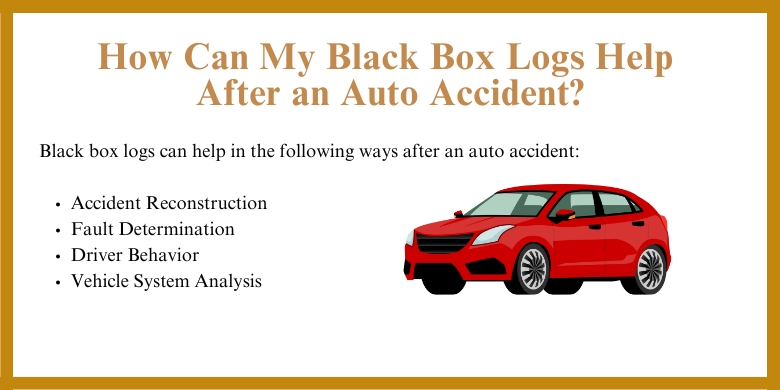
How Can My Black Box Logs Help After an Auto Accident?

A car’s black box provides valuable information after an auto accident. Even if there were no witnesses or traffic camera video, a black box can fill in the blanks and answer questions about liability. Commercial vehicles have similar embedded devices, which are helpful if you are injured in a truck accident.

How Can My Black Box Logs Help After an Auto Accident

Black box logs can help in the following ways after an auto accident:

Accident Reconstruction

Accident investigators can recreate the sequence of events leading up to the accident and determine factors such as the speed of the vehicles involved, the timing of braking or acceleration, and whether any safety measures were deployed.

Fault Determination

Black box logs can help identify sudden changes in speed, abrupt braking, or aggressive maneuvers that might suggest negligent or reckless driving. This information can be helpful in settling insurance claims or determining liability in a car accident lawsuit.

Driver Behavior

The data from black box logs might indicate whether the driver was distracted, fatigued, or engaged in unsafe driving practices, such as excessive speeding, texting, using a cell phone, or sudden lane changes.

Vehicle System Analysis

Sometimes, the failure of a car’s safety system causes or contributes to a crash. Black boxes capture data related to the activation of airbags, the functioning of stability control systems, and other safety features. This information can help determine whether the vehicle was operating as intended and whether any malfunctions or defects contributed to the accident or injuries.

Who Can Access My Black Box Information?

Although black box logs can provide valuable information about a crash, they raise privacy concerns. The state of New Jersey has a specific law designed to limit access to black box data to the vehicle’s owner and others under specific circumstances:

  • Auto dealers
  • Mechanics
  • Law enforcement agencies, after obtaining a warrant
  • Attorneys, pursuant to discovery rules or court order

What Is the Filing Deadline for My Auto Accident Lawsuit in New York?

A car accident lawyer can protect your rights and help you seek money from the at-fault party. In New York, the statute of limitations for filing a personal injury lawsuit generally allows three years from the date of the injury to file suit. In New Jersey, the deadline is generally two years from the date of the injury.

However, it takes time to build a strong case and to acquire evidence, including information from a vehicle’s black box. If you’re hurt and want to know your legal options after a car crash that was someone else’s fault, contact an experienced car accident attorney today.

Contact Davis, Saperstein & Salomon, P.C. for a Free Consultation

The information in a car’s black box could help prove fault against the liable party who caused the accident and your injuries. The attorneys with Davis, Saperstein & Salomon, P.C. have recovered over $1 billion in combined verdicts and settlements for more than 35,000 clients in New York and New Jersey. It costs nothing for you to talk to us about your case. We have many convenient locations in New Jersey and New York City, and we can also meet you over FaceTime, Zoom, or Skype.

Contact Davis, Saperstein & Salomon, P.C. today for a free consultation.

The post Everything You Need to Know About Black Boxes in Cars appeared first on Davis, Saperstein & Salomon, P.C..

from Davis, Saperstein & Salomon, P.C. https://www.dsslaw.com/blog/black-boxes-in-cars/
via https://www.dsslaw.com/

About Personal Injury Lawyers

About Personal Injury Lawyers

By Garry R. Salomon, Esq.
Published in The Trial Lawyer Magazine
Published by The Trial Lawyer, Inc.
June 2024 Issue

A lot of people like to make jokes about personal injury lawyers. Perhaps some of that is brought about by tasteless attorney advertising or questionable tactics employed by some injury attorneys to find new clients. When 1 explain to some people what I do, they feel it necessary to respond, “So, you mean you’re an ambulance chaser.” I smile and laugh at their joke because 1 realize they mean no harm. The jokes may seem to be funny, but to someone who’s injured, it’s no laughing matter.

Similarly, law professors who educate future lawyers with the aspiration that their students may, upon graduation, land a job with “Big Law” seem to frown upon recommending their students to consider a career dedicated to being a personal injury “trial attorney.’ Instead, they prefer their students to engage in corporate legal work. Somehow, to them, a career of contract reviews, foreclosure law, and perhaps real estate transactions is more noble. As a result, few law students are encouraged to enter a career specializing in “tort law,” commonly known as Personal Injury Law. Fortunately for me, I know otherwise.

As a law student with an undergraduate degree in accounting, my intention was to become a tax attorney. However, that changed as soon as I studied tort law, which is about compensating people injured by another’s negligence. Having started my legal career as a general practitioner, I found it most satisfying to devote my career to being an “injury lawyer.”

I found that by being an injury lawyer, I became not only a member of the “Plaintiffs bar”, but more like being part of a fraternal organization. Even though plaintiff trial lawyers may compete with one another for clients, they were open and collaborative about sharing trial skills to be effective advocates for their injured clients. More importantly, they are active in lobbying, passing, and advocating for pro-consumer laws that hold negligent corporations and institutions accountable for their negligence. It was then that I understood that each case I brought helped make the world a bit safer.

You see, in our society, law enforcement protects against crime, but who protects the people against neglect, malfeasance, and carelessness? I then truly understood the trial lawyer’s contribution to society. Because if it weren’t for the work of trial attorneys, cars would not be as safe, food would not be as wholesome, prescription drugs would not be as safe, and police brutality would go unchecked. There would be no seat belts, functional airbags, flame-proof baby clothing, mall security, back-up alarms, product warnings, etc. Corporations have no hearts, souls, or consciousness. They exist to make money, and it’s the fear of being sued that causes them to institute safety protocols.

There was a time when, during snowstorms, storekeepers would stock rock salt for sale, yet not apply any to their own walkways. Now, because of the threat of lawsuits, they make certain to de-ice their parking lots. When it snows, the manager may tell an employee, “Go salt the entryway before someone slips and sues us.” But they have it all wrong. What management should say to their porter is, “Go clear the snow and salt the parking lot before some woman falls and breaks her hip, and because of that, she may lose her job since she can’t go to work. Furthermore, because the woman lost her job, her house may go into foreclosure, and because of her pain, she can’t take care of her disabled husband and even ends up missing her granddaughter’s wedding. Now go outside and clean and salt the parking lot!”

The truth of the matter is that the store owner only cares about not being sued.

Not only am I proud of the work that I do, but I also realize that trial lawyers need far more skills than other lawyers. We need to know all the applicable statutes and case law. We need to know Evidence Law inside and out. We need to understand other areas of the law, including real estate, partnerships and corporations, civil procedure, family law, estate law, criminal law, bankruptcy, contracts, and constitutional law. We also need a good understanding of medicine, accounting, engineering, and psychology. We learned to be good legal brief writers and, above all, “good on our feet” in front of a jury. We need good investigation and negotiation skills as well as a good understanding of human nature, and good debating and theatrical skills.

On top of it all, we trial lawyers need to have enough confidence in ourselves to win our clients’ cases, because if we don’t win their case, we will not get paid. But despite it all, I would not change a thing in my career. In fact, often while trying a case, I say to myself, “I can’t believe that I get to do this.”

During my career, I’ve had the privilege of interviewing hundreds of lawyers for a position at my firm. When asked why they decided to go to law school, they all say that they became lawyers “to help people.” Well, the reality is that we trial lawyers are the lawyers who really do help people from all walks of life, whether they are old or young, rich or poor. In the end, by doing our jobs, we helped a person or a family get their measure of justice while making the world a safer place.

And that’s what it means to be a trial lawyer.

The post About Personal Injury Lawyers appeared first on Davis, Saperstein & Salomon, P.C..

from Davis, Saperstein & Salomon, P.C. https://www.dsslaw.com/blog/about-personal-injury-lawyers/
via https://www.dsslaw.com/

Can You Sue for Emotional Distress After a Car Accident in New Jersey?

Car accidents can be devastating, physically and emotionally. A car accident lawsuit can compensate for physical losses and medical expenses, but what about the emotional after-effects of a crash? Can you sue for emotional distress after a car accident?

The answer is yes, provided that you hire the right lawyer for your case. While it is possible to recover damages based on emotional distress, the best way to determine whether your case qualifies is to contact a personal injury attorney who knows the law, ideally sooner rather than later. 

In fact, any lawyer who overlooks emotional injuries does not understand what a personal injury case is really about. While most lawyers see only physical injuries, the attorneys at Davis, Saperstein & Salomon, P.C. also see emotional injuries, such as post-traumatic stress disorder (PTSD), driving phobias, and anxiety. We believe that greater emotional injury is derived from the injured person not being able to enjoy the passionate things in their lives that gave them great pleasure. In other words, we put the “personal” in personal injury by getting to know and understand you as a person.  

For example,

…there is the young woman who now has a facial scar or can no longer pick up her toddler. 

…or the young college athlete who injured his knee and can no longer play basketball.  

…what about the 65-year-old man who just retired to Florida to live on a golf course and can no longer play golf?

… and then there is the religious woman who can no longer kneel at church and can’t participate in church events in the kitchen and help serve the needy at charitable events.

… then there is the grandmother who can no longer host Sunday afternoon dinners or decorate for Christmas due to her injuries.  

…or the young man who was saving his money for a down payment on a house, and because of a car accident with a truck, he was out of work for 3 months, blew through his savings, lost his job and his income, and his 740-credit score dropped to 500. 

…or the anesthesiology operating room nurse who can no longer mentally concentrate in the operating room due to back pain and the concussion she suffered during a car crash.    

These are typical physical injury claims causing changes that result in a loss of joy to accident victims living with permanent emotional scars.  

Often, a physical injury will heal or stabilize, but the emotional and psychological losses linger on. When a person suffers a physical injury that causes a scar, limp, or back injury that results in a loss of mobility or bodily function, there is always an emotional loss because they can no longer fully engage in their activities that they are passionate about.  

We find that people with facial scars often feel self-conscious. Others with restrictive neck and back injuries sometimes lose the ability to feel good about themselves due to intangible loss of body function or restriction in mobility.

Why Choose Our New Jersey Car Accident Lawyers?

If you’re feeling overwhelmed after a car accident and looking for help, you’ve come to the right place.

At Davis, Saperstein & Salomon, P.C., we pride ourselves on putting the “personal” in personal injury. That means you are not a mere file, case, or claim to us. You are a person who has suffered unique injuries that have likely affected your health, your emotional well-being, and your everyday life. 

We provide personalized, individual attention to each person we help. We have over 100 employees, 25 of whom are licensed New Jersey or New York lawyers, ready to fight for the results you deserve. With over 40 years of experience, more than $1 billion in verdicts and settlements, and over 35,000 people helped, we know how to get results for our clients.

Contact us today to learn more about how we can help. We offer translation services if English is not your preferred language, and we’re happy to meet in person or virtually via Zoom or FaceTime. There’s no charge for the consultation, and we only get paid if we recover money for you.

How is Emotional Distress Defined?

The mental trauma associated with a car accident can be significant, but what is the legal definition of emotional distress?

According to New Jersey law, emotional distress is defined as “significant mental suffering or distress.” This can take the form of fright, anxiety, nervousness, anguish, grief, depression, or anger. If your mental well-being is suffering to the point where it’s hard to go about your day, you may be experiencing emotional distress. 

Can You Sue for Emotional Distress After a Car Accident in New Jersey?

In short, yes. In New Jersey, you have two options for seeking money for emotional distress: intentional infliction or negligent infliction.

Under intentional infliction of emotional distress, you must prove that your mental anguish resulted from ongoing harassment. This harassment must be “so outrageous in character, and so extreme in degree, as to go beyond all possible bounds of decency.”

Under negligent infliction of emotional distress, this can result from a single incident. The person who caused the car accident may not have meant to harm you physically or emotionally. Still, if their negligence in causing the crash was the primary cause of your suffering, they could be held liable.

In fact, it is written in the law, and at the end of a trial, just before the jury goes into their deliberations, the Judge will read the jury charge, which includes:

CHARGE 8.11E 
8.11 DAMAGES CHARGES  

GENERAL, DISABILITY, IMPAIRMENT, AND LOSS OF THE ENJOYMENT OF LIFE, 

PAIN AND SUFFERING

If you find the Plaintiff is entitled to recover fair and reasonable compensation for the full extent of the harm and losses caused, no more and no less. Fair and reasonable compensation means making Plaintiff whole for any permanent or temporary injury and the consequences of that injury (or injuries) caused by the defendant’s negligence (or other fault). The law on compensation recognizes that a plaintiff may recover for any disability or impairment that he or she suffers as a result of his or her injuries. Disability or impairment means worsening, weakening, or loss of faculties, health, or ability to participate in activities. The law also permits a plaintiff to recover for the loss of enjoyment of life, which means the inability to pursue one’s normal pleasure and enjoyment. 1- You must determine how the injury has deprived Plaintiff of [his] [her] customary activities as a whole person. 2- This measure of
compensation is what a reasonable person would consider to be adequate and just
under all the circumstances of the case to make Plaintiff whole for [his] [her]
injury and [his] [her] consequent disability, impairment, and the loss of the enjoyment of life. The law also recognizes as proper items for recovery, the pain, physical and mental suffering, discomfort, and distress that a person may endure as a natural consequence of the injury. Again, this item of recovery is what a reasonable person would consider to be adequate and just under all circumstances to compensate Plaintiff. Here are some factors you may want to take into account when fixing the amount of the verdict for disability impairment, loss of enjoyment of life, pain, and suffering. You may consider [Plaintiff’s] age, usual activities, occupation, family responsibilities, and similar relevant facts in evaluating the probable consequences of any injuries you find [he] [she] has suffered. You are to consider the nature, character, and seriousness of any injury, discomfort, or disfigurement. You must also consider their duration, as any verdict you make must cover the harms and losses suffered by Plaintiff since the accident, to the present time, and even into the future if you find that [Plaintiff’s] injury and its consequence have continued to the present time or can reasonably be expected to continue into the future. The law does not provide you with any table, schedule, or formula by which a person’s pain and suffering, disability, impairment, and loss of enjoyment of life may be measured in terms of money. The amount is left to your sound discretion.

Damages You Can Recover for Emotional Distress in NJ

In car accident claims, you can seek both economic and non-economic damages. Economic damages have a clear monetary value: lost wages from work, medical bills, physical therapy bills, repair costs, etc.

Non-economic damages are more complicated to put a price tag on, but they are just as real and just as compensable. They are the largely emotional or intangible costs of an accident or injury. Emotional distress is a type of non-economic damage. Additionally, depending on your situation, your lawyer could seek money for damages like:

  • Loss of enjoyment of life
  • Loss of a loved one
  • Pain and suffering
  • Humiliation
  • Mental anguish and trauma
  • Scarring and disfigurement
  • Permanent impairments
  • Disabilities

New Jersey has no cap on non-economic damages.

Can my Spouse Make a Claim and Sue for their Emotional Damages?

The answer is yes. Spouses, including domestic partners, can sue for money damages as part of their spouse’s case if they themselves suffered a loss of enjoyment of their life, a devaluation of their marriage, or they had to assume a greater financial burden. This is called a loss of consortium claim, and it is considered a derivative claim. However, if they were within the zone of danger and they witnessed a catastrophic injury, then they too would have a direct claim under the New Jersey case Portee v. Jaffee.  

Talk to an Experienced Personal Injury Attorney in New Jersey Today

Suing for emotional distress after a car accident is complicated, especially when proving intangible, emotional damages. You need a skilled personal injury attorney who can prove that your emotional pain is real and taking a toll on your life. We fight aggressively for our clients and pursue every possible avenue of justice. 

The car accident attorneys at Davis, Saperstein & Salomon, P.C., help people throughout New Jersey and New York City, and we are happy to meet with you in person or over a video call. Schedule a free consultation today by calling us or contacting us online.

The post Can You Sue for Emotional Distress After a Car Accident in New Jersey? appeared first on Davis, Saperstein & Salomon, P.C..

from Davis, Saperstein & Salomon, P.C. https://www.dsslaw.com/blog/emotional-distress-after-a-car-accident-in-new-jersey/
via https://www.dsslaw.com/

Design a site like this with WordPress.com
Get started