
United States Post Office Deadly Truck Accidents

As long as their package arrives on time, many Americans might not think twice about the agency or company delivering it. But it’s important to study and analyze the practices of all large organizations, including Amazon and Starbucks, but also the United States Postal Service (USPS). Two weeks ago, the Wall Street Journal published an article on USPS, revealing alarming information about the federal agency and its practices.

USPS faces competition from private shipping companies like the United Parcel Service Inc. (UPS) and FedEx Corp. USPS receives some of its funds from the federal government, but most of its funds come from selling postage. To increase its revenue, USPS hires external trucking contractors at cut-rate prices, requires truckers to meet unmanageable delivery schedules, and continues working with contractors, even after their truckers violated traffic safety regulations.

John Sheehy, president of the National Star Route Mail Contractors Association, told the Journal that USPS offered its contractors rates that were 15-20% below industry standards. This allows USPS to hold onto more of its funding, but at the expense of the truck drivers.

The Department of Transportation (DOT) has strict rules regulating truck drivers and the amount of time that they can operate their vehicle. DOT regulations state that a truck driver cannot drive more than a total of eleven hours in a day and may not work for more than fourteen hours a day (including stops and truck loading time). The DOT established these safety regulations because research has shown that ‘drowsy driving’ substantially increases the risk of getting into a car accident. Research has even suggested that 24 hours of sleep deprivation causes roughly the same effects as having a BAC of 0.10%. Violation of these regulations leads to the decreased safety of the drowsy driver, other drivers on the road, and pedestrians.

In civil cases where the plaintiff was involved in an accident with a commercial truck driver, the plaintiff’s attorney will often look for evidence that the truck driver had violated DOT regulations. For example, the attorney may look at the driver’s records from the day of the accident to see if they had worked more hours than DOT allows for.

Sheehy, who himself is a former USPS contractor, told the Journal that there is immense pressure to make scheduled delivery times. Sheehy added that in previous years, USPS has chosen to terminate contracts with contractors that failed to make at least 95% of their deliveries on-time.

The Journal reviewed a series of USPS contracts and found one route that required the driver to leave Salt Lake City at 3:30 AM and arrive in San Francisco at 5:30 PM. This route is a fifteen-hour drive, which is one more hour than the fourteen-hour maximum amount of time worked that DOT allows for. This example is part of a larger pattern–the DOT reported that, from 2021 to 2022, about 39% of USPS’s trucking companies had violated its regulations, compared to only 13% of for-hire trucking companies.

One of USPS’s most important vendors, McCormick Trucking, clocked over 200 DOT violations between 2017 and December of 2022. Its sister company, Tracie McCormick Inc., has also been fined by the DOT for violating safety regulations. Even in light of both companies’ poor safety records, USPS has continued working with McCormick Trucking and Tracie McCormick Inc., and extending existing contracts.

Unfortunately, the Postal Service did not track crashes caused by its contractors. It did not require contractors to report accidents to USPS, but this policy has recently changed since the Journal’s article. USPS now requires its contractors to notify USPS of fatalities, injuries, or significant property damage after a serious accident occurs.

One serious accident occurred in June of 2022, when five people, including a baby, were killed after a Postal Service truck driver struck their car. The accident occurred on Interstate 25, near Denver, Colorado, and police later reported that the accident had been caused by the truck driver’s distracted operation of his vehicle. Police also learned that the driver lacked a valid commercial driver’s license.

Since USPS has established a mandatory reporting guideline, Americans should hope to see more accountability from USPS and its contractors, as well as greater adherence to DOT safety regulations.

If you or someone you know has been involved in a car or truck accident, the attorneys at Davis, Saperstein & Salomon, P.C. have decades of experience and may be able to help.

Our firm offers free and confidential case evaluations and are available 24/7. Contact us today by calling 201-444-4444.

Scene of the Denver, June of 2022 Crash

Scene of the Denver, June of 2022 Crash

The post United States Post Office Deadly Truck Accidents appeared first on Davis, Saperstein & Salomon, P.C..

from Davis, Saperstein & Salomon, P.C. https://www.dsslaw.com/blog/united-states-post-office-deadly-truck-accidents/
via https://www.dsslaw.com/
Insights from Samuel L. Davis: Facial Recognition in NYC and its Impact on Consumer and Worker Protection

On February 24th, 2023, Davis, Saperstein & Salomon, P.C. Founding Partner Samuel L. Davis, Esq., testified before The New York City Council Committee on Consumer and Worker Protection about the use of facial recognition technology in New York City businesses.

How Can New York Businesses Use Facial Recognition Technology to Ban Your Right to Free Speech

In November 2022, Davis, Saperstein & Salomon Associate Kelly A. Conlon, Esq. was escorted out of Radio City Music Hall as she tried to attend a Christmas show with her daughter and her girl scout troop. Conlon was identified using facial recognition technology and was asked to leave the premises. This was done simply because she is an attorney with Davis, Saperstein & Salomon, who happened to represent an individual in a personal injury matter against a restaurant that was later acquired by Madison Square Garden. Conlon not only was not involved in the lawsuit, but she had no knowledge of it.

Madison Square Garden has gone on to ban over 2,000 lawyers from over 90 other law firms who are involved in lawsuits against one of their entities.

“We have no real concept of how invasive this technology is,” says Sam Davis as he spoke before the committee. “Please do not let companies like MSG turn public accommodations into places where you leave your right to free speech at the door.”

Private Businesses in New York Using Facial Recognition Technology Need to Be Transparent

In New York City, the use of facial recognition technology may be legal if the company posts a notice to consumers stating that the technology is being used, and that it does not use it to make a profit or share it with third parties. After Conlon’s experience at the Radio City Music Hall, Sam Davis visited the venue to experience what she felt. While there, he observed MSG’s notice to consumers. “The signage was inconspicuously posted. In other words, the signs were facing sideways”, says Sam Davis. While MSG does post signs to alert consumers that they are using this technology, the signs were neither conspicuous nor in compliance with the law.

The notices also did not reveal the true intention behind the use of facial recognition. “The signs only list ‘for security purposes only’. That’s a misrepresentation”, says Sam Davis. Facial recognition may have a valid role to play in identifying individuals who might jeopardize the safety of patrons, performers or staff. The technology may be searching for legitimate security threats, but at MSG it also searches for enemies of its owner, in this case civil attorneys who pose absolutely no threat to safety.

Davis argued for transparency when it comes to the use of facial recognition technology regarding what these “security measures” will ultimately be used for and for how long. “The problem is, there is no transparency,” he says. “The law must be very clear and provide a mechanism for enforcement.”

By interfering with lawyers’ rights to represent Americans, Madison Square Garden has curtailed the First Amendment right to free speech. It has also tried to limit the Fourth Amendment right to privacy by inappropriately using biometric information and facial recognition technology. “If MSG can get away with this, then you are going to have a slippery slope of surveillance in the city… Our privacy will be nothing more than a quaint memory of what life was like at the turn of the century”, said Davis.

About Davis, Saperstein & Salomon, P.C.

Davis, Saperstein & Salomon, P.C. is a personal injury law firm based in Teaneck, New Jersey, with satellite offices in New York and other parts of New Jersey. Our attorneys handle a wide variety of cases, including motor vehicle accidents, premises liability and construction accidents. Since its founding in 1981, Davis, Saperstein & Salomon, P.C., has been committed to representing the individual and never the corporation. The Firm is also committed to protecting our right to privacy, in the face of MSG and other corporations’ unethical use of facial recognition technology.

This is not a commitment that Davis, Saperstein & Salomon, P.C., makes alone. “We must do what we can, as a city, to protect New Yorkers’ privacy and guard against these products being used to harm consumers and workers”, said Councilwoman Marjorie Velasquez, Chair of the Committee on Consumer and Worker Protection.

The post Insights from Samuel L. Davis: Facial Recognition in NYC and its Impact on Consumer and Worker Protection appeared first on Davis, Saperstein & Salomon, P.C..

from Davis, Saperstein & Salomon, P.C. https://www.dsslaw.com/blog/facial-recognition-in-nyc/
via https://www.dsslaw.com/

4-Year-Old Attacked by a Pit Bull in New Jersey

Kind dogs may be man’s best friends, but aggressive dogs can cause severe physical and psychological injuries when they attack. Sadly, that is exactly what happened recently when a pit bull attacked a 4-year-old girl and her mother in New Jersey.

According to news reports, Khaleen Brown Anderson and her daughter, Abbey, had just returned to their home in Teaneck when Anderson saw a pit bull running up the street toward them. Anderson said the dog attacked her and her daughter, even jumping into the car at one point.

The attack ended when a plumber working nearby heard the attack and scared the dog away. Police impounded the dog and served its owner with two summonses. Records show the dog had previously attacked a mailman in 2017. A judge will decide what happens to the dog now.

The psychological effects have already impacted Abbey. Brown Anderson reports the 4-year-old is traumatized and cries in her sleep.

What Should I Do After a Dog Attack?

If you get hurt in a dog attack, take the following key steps:

  • Call the Police – It is necessary to document the attack but more importantly the police will investigate the true owner of the animal.
  • Seek medical attention immediately – Dogs can cause severe injuries when they attack, including puncture wounds, soft-tissue injuries, broken bones, and nerve damage. Seek medical care and make sure you get a rabies vaccine.
  • Identify the dog and contact its owner – Take pictures of the dog for reference if you can. If you contact the dog’s owner, keep the conversation brief and do not speculate about what caused the dog to attack. Ask the owner for their insurance information, contact details, and the dog’s vet medical records.
  • Document your injuries – Take pictures of any visible injuries you sustained and store the pictures in a secure location. You should also save your medical records for future reference and start a journal to document how the attack affects you mentally and emotionally.
  • Do not make any social media posts about the attack – A stray comment or photo could hurt your chances of recovering compensation for your injuries. Stay away from social media until your case settles.
  • Do not speak to any insurance companies – The dog owner’s homeowners insurance company may call you and pressure you to accept a quick settlement. However, their offer likely won’t cover the full extent of your injuries. Let your lawyer handle all communication with the insurance companies.
  • Hire a dog bite lawyer – Securing compensation for a dog bite claim can be difficult, and you want to recover as much as possible. A dog bite attorney can help you protect your rights and demand the money you need. Special discounted fee rates apply to children bit by a dog.

What Are the Physical and Psychological Consequences of Dog Attacks?

The physical consequences of a dog attack are often serious and can include:

  • Severe injuries, including broken bones, facial injuries, infections, and internal bleeding
  • Scarring and disfigurement
  • Long-term pain from your injuries
  • Rabies and prophylactic treatment for rabies
  • Tetanus

The psychological consequences of a dog attack are often as severe, especially when a child is bit by a dog, as the physical effects and may include:

  • Nightmares and insomnia
  • Flashbacks to the attack
  • Heightened anxiety, especially around dogs
  • Depression and other emotional distress
  • Psychological distress from pain, scarring, and disfigurement

What Compensation Can I Get After a Dog Attack?

With help from the right attorney, your compensation after a dog attack in New Jersey could include money for:

  • Medical bills
  • Future plastic surgery bills and revision surgery
  • Incidental expenses
  • Lost wages
  • Lower future earnings
  • Scarring and disfigurement
  • Pain and suffering
  • Emotional distress

What is the New Jersey Law Governing Dog Bites?

The owner of any dog which shall bite a person while such person is on or in a public place, or lawfully on or in a private place, including the property of the owner of the dog, shall be liable for such damages as may be suffered by the person bitten, regardless of the former viciousness of the such dog or the owner’s knowledge of such viciousness.

If the injury occurs when entering the private property where the dog is kept, the law states that a person is lawfully upon the private property of such owner when on the property in the performance of any duty imposed by the laws of this state or the laws, such as a cable installer, worker, or postal worker, such as a mail carrier of the United States, or when a person or child is on such property upon the invitation, express or implied, of the owner thereof. 

Contact Our New Jersey Dog Bite Lawyers for Help

The team at Davis, Saperstein & Salomon, P.C. understands how traumatic dog attacks can be. We’re here to help you recover fair compensation for your injuries. Contact us today to learn more about your rights in a free consultation with a New Jersey dog attack attorney.

The post 4-Year-Old Attacked by a Pit Bull in New Jersey appeared first on Davis, Saperstein & Salomon, P.C..

from Davis, Saperstein & Salomon, P.C. https://www.dsslaw.com/blog/4-year-old-attacked-by-pit-bull-in-new-jersey/
via https://www.dsslaw.com/

FAQs: Car Accident While Pregnant

It is estimated that four percent of the US population is pregnant at any given time, so statistically four out of every injured client may be pregnant.  Women expecting a child do everything they can to protect their unborn child. Unfortunately, no amount of precaution can eliminate the risks women face in their daily lives. However, what happens if a woman is involved in a car accident while pregnant? Does the unborn child have a higher risk of injury? What compensation could the pregnant mother be owed by the person who caused the collision? How can you or that person make a claim?

Here are the answers to these and other questions we often hear from our clients who were pregnant when they were in a car accident.

Can a Car Crash Affect Your Pregnancy?

The short answer is yes for injuries to the mother and injuries to the child.  In fact, New Jersey certain injuries to a fetus are specifically written into New Jersey’s automobile injury laws.

An injury to a pregnant woman is unique in that the expecting mom is more concerned about her child’s potential injures than her own.  Being pregnant carries with it its own set of complications and often causes back and abdominal pain and discomfort.  To determine if such pain is related to a car accident XRAYS and other radiology tests are necessary.  That is the first problem, proper diagnosis without imaging.  Although in utero injuries are rare, injures to the expectant mom are common.  These injuries to the neck and back are often caused by the seatbelt. Most common injuries to a pregnant mom are to their necks and lower back.  Seldom is there an injury to an unborn child, however sometimes pregnancies are lost because of a car wreck.

Studies have found that car accidents account for 1,500 to 5,000 miscarriages each year. Even if a pregnant person doesn’t miscarry, their unborn child may suffer fetal trauma causing permanent disabilities.

The most common injuries from car accidents during pregnancy include:

  • Placental abruption happens when the placenta detaches from the uterine wall. Around 5 percent of pregnant people in low-impact accidents and as many as 50 percent of those in high-impact accidents suffer placental abruption.
  • Uterine rupture is a medical emergency with a high fetal mortality rate. It is not common but occurs when the uterine wall tears or rips. Most cases result from seat belts or deployed airbags.
  • Maternal shock occurs when the pregnant person sustains severe injuries. The body copes with blood loss by rerouting blood to essential organs, which deprives the fetus.
  • Direct fetal trauma is an injury the fetus suffers directly rather than as a side effect of the mother’s injuries. About 10 percent of car accidents involving pregnant people result in direct fetal trauma. Head injuries caused by impact with a steering wheel, airbag, or seat belt are most common.
  • Emotional and Psychological Injuries to the Expecting Mother are common and often remains a question after birth as the child develops through childhood. Mothers often worry and wonder if any developmental problems suffered by a child can be attributed to a past motor vehicle accident.

Accident injuries sustained by fetuses may lead to disabilities later in life. For example, head trauma often causes developmental or intellectual delays. If you are in a car accident while pregnant, watch a child’s development closely for signs of injury after birth.

Can a Car Accident While Pregnant Cause Brain Damage to a Fetus?

Placental abruption can cause brain damage by restricting blood flow to the developing baby. It is a medical emergency and often requires a C-section to avoid further injury to the infant.

Uterine rupture, while uncommon, can also cause brain damage and cut off oxygen to the fetus. Like placental abruption, it often needs an immediate C-section.

The abdominal wall and uterus often provide sufficient protection. However, direct impacts can cause fetal head trauma. The fetus’s head is most at risk for direct fetal trauma, causing damage that may manifest as long-term disabilities later in life.

Can a Seat Belt Injure a Fetus After a Crash?

A seat belt can cause injuries in higher-impact crashes, including placental abruption, uterine rupture, and direct fetal trauma. However, it is more dangerous not to wear a seat belt than to use it. Wear the seat belt as recommended but ensure the lap belt secures below your belly and snuggly across your pelvic bone and hips.

Are Airbags Dangerous While Pregnant?

Like seat belts, airbags may pose a danger in some circumstances. But there is no higher risk of fetal distress or injury when airbags deploy. Keep 10 inches of space between the steering wheel and your breastbone. If possible, angle the steering wheel to face your chest rather than your belly.

What Are Some Warning Signs to Watch Out for After a Car Accident While Pregnant?

If you were in a car accident while pregnant, watch out for the following:

  • Severe abdominal pain
  • Vaginal bleeding
  • Urgent or painful urination
  • Dizziness or loss of consciousness
  • Swelling in your face or fingers
  • Chills and fever
  • Severe headaches
  • Changes in the baby’s movement

Not all fetal injuries will manifest symptoms in the parent. It is a good idea to visit the doctor after a car accident – regardless of how you feel or what symptoms you may have experienced.

Once your baby is born, keep an eye on their development. Let your pediatrician know you were in a car accident while pregnant so they can assess your child’s development more thoroughly. The consequences of head injuries are often not apparent until the child is older.

What to Do If You’re in a Car Accident While Pregnant

If you haven’t already, see your doctor. Even if you don’t feel injured, it is a good idea. Once you are home, watch out for symptoms that may indicate a fetal injury.

Follow through with any additional treatment your doctor recommends. If left untreated, injuries like neck and back pain can worsen during pregnancy and even leave you with permanent pain and disability.

As your healing and pregnancy progress, document your experience in a journal. Note any unusual pain or mental stress. These items can be compensable through an insurance claim or lawsuit against the at-fault party.

Should You Hire a Lawyer If You Were Involved in a Car Crash While Pregnant?

Pregnancy complicates injuries. Your baby may have suffered long-term damage you aren’t yet aware of. An insurance company will likely fight you if you file a claim for your child’s developmental problems years after the accident. The limited window to file a lawsuit set by the statute of limitations can also present its own challenges. The sooner you speak with a lawyer, the more they can do for you.

You will likely face stress after a crash while pregnant. That could affect your baby’s development and cause birth complications later. One way to manage this stress is to delegate insurance claims and settlement tasks to an attorney.

Your attorney can sue the careless driver and their insurance company for your harms and losses  associated with the car accident, including:

  • Your medical bills and neonatal diagnostic tests
  • Medical treatment for you and your unborn child
  • Money for your temporary and permanent pain and suffering
  • Money for your lost wages from being unable to work.
  • Delivery related complications
  • Future medical care for your baby
  • Money for your emotional distress and PTSD

New Jersey has a unique law that affects people subject to the Limitation of Lawsuit Threshold, also known as Limited Tort or the Verbal Threshold.  This New Jersey law can limit a person with non-permanent injuries right to bring a lawsuit.  However, the law plainly states that the loss of a fetus is a permanent injury and will allow the woman who suffered the miscarriage to sue for the loss of the pregnancy and all other injuries.

Your claim can become complex quickly, especially if your child shows effects from the accident later. Rather than fight the insurance company on your own, contact Davis, Saperstein & Salomon, P.C. for a free consultation with a compassionate car accident lawyer at 1-800-LAW-2000.

We can meet with you in our locations in New Jersey and New York City, over the phone, or through video chat. With more than 40 years of experience, we have secured over $800 million in verdicts and settlements for our clients. Let us put our skills, resources, and knowledge to work to help demand the financial recovery you need to get life back on track for you and your child.

The post FAQs: Car Accident While Pregnant appeared first on Davis, Saperstein & Salomon, P.C..

from Davis, Saperstein & Salomon, P.C. https://www.dsslaw.com/blog/car-accidents-while-pregnant-faq/
via https://www.dsslaw.com/

Teen Drivers: Are They More Dangerous?

During the late afternoon of Friday, January 27, a Nissan Pathfinder with a teenage driver and four teenage passengers crashed into a “No Parking” sign and a telephone pole in Ridgewood, New Jersey. Four of the five teenagers were released to their parents after emergency services arrived at the scene, but one of them was transported to Valley Hospital in Ridgewood. The accident occurred on Marshall Street, close to Ridgewood High School.

Sadly, vehicle-related accidents like this one are the leading cause of death among teens in the U.S., the Centers for Disease Control and Prevention (CDC) reports.

According to the National Highway Traffic Safety Administration (NHTSA), young drivers (those between the ages of 15 and 20) account for only 5.1% of the country’s total number of licensed drivers, and yet they account for 8.5% of fatal crashes. In 2020, the latest year of reporting:

  • 1,885 young drivers lost their lives in motor vehicle accidents
  • 189,950 young drivers sustained injuries in crashes
  • 4,561 young drivers were involved in accidents that led to fatalities.

Dangerous Driving Habits Teens May Adopt

For many reasons, including the exhilaration they experience upon driving for the first time, teenagers are susceptible to dangerous driving habits.

These habits cause teen drivers to be a danger to themselves and to others on the road. Some of the habits they may engage in include:

  • Texting while driving
  • Talking on hand-held or hands-free cell phones while driving
  • Drinking and driving
  • Speeding
  • Tailgating
  • Driving without wearing a seatbelt
  • Adjusting the radio
  • Making changes to in-vehicle navigation systems
  • Eating while driving
  • Taking “selfies” or attempting to post to social media while driving.

Besides these bad driving practices, there are other factors that put your teen driver directly in harm’s way. These include:

  • A lack of defensive driving training
  • Inability to recognize potentially hazardous situations
  • Driving with other teen passengers
  • Driving at night
  • Driving while tired or drowsy
  • Engaging in risky driving behavior at the encouragement of their peers

The bottom line is that any time a teenager takes his or her eyes off the road, places their hands off the wheel, or stops paying attention to the task of driving, the driver and many other lives may be put at risk.

What Is Being Done to Make Teen Drivers Safer?

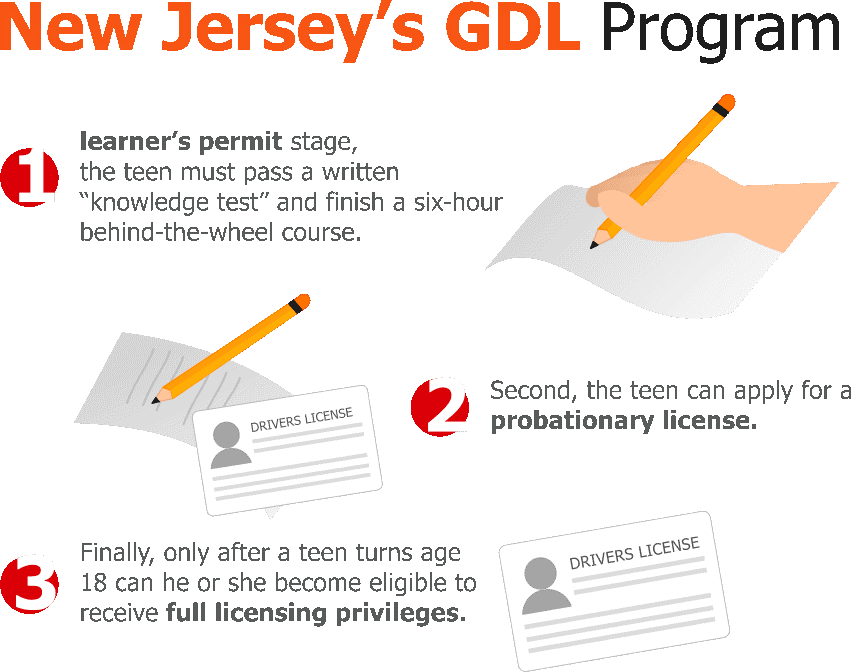
Fortunately, each state has enacted Graduated Driver Licensing (GDL) laws which allow new, inexperienced drivers to gradually earn their driving privileges. This way, a teen driver can minimize his or her risk of being involved in a crash.

Under New Jersey’s GDL program, teen drivers must go through a three-stage process before they can become fully licensed:

New Jersey's GDL Program

Additionally, in New Jersey, drivers with learner’s permits or probationary licenses who are under age 21 cannot use any electronic device – hand-held or hands-free – while driving.

Contact The New Jersey Teen Driving Accident Lawyers at Davis, Saperstein & Salomon, P.C. For Help

Parental involvement is essential to teen driving safety. When parents set a good example for their teen driver, he or she will be more likely to adopt safe driving habits. Parents can set this good example by following the rules of the road, practicing defensive driving, and never using electronic devices behind the wheel or driving after drinking. They should also always wear a seatbelt.

If you or a loved one has been injured in a crash involving a teen driver, you should contact an attorney without delay in order to protect your right to just compensation. Call Davis, Saperstein & Salomon, P.C., at 1-800-LAW-2000 or submit our online form to receive a free consultation.

The post Teen Drivers: Are They More Dangerous? appeared first on Davis, Saperstein & Salomon, P.C..

from Davis, Saperstein & Salomon, P.C. https://www.dsslaw.com/blog/are-teen-drivers-dangerous/
via https://www.dsslaw.com/

Steps to Take After Being Injured in a Hit-And-Run

On January 20th, 61-year-old Deborah Peko-Lillis was struck and killed by a hit-and-run driver on Hoboken Road in Carlstadt, New Jersey. The driver, Justinian Cuevasmetemi, fled the scene. He was then arrested and charged with second-degree leaving the scene of a motor vehicle resulting in death, and third-degree endangering an injured victim.

A hit-and-run is a collision in which the driver at fault doesn’t stop to exchange information or offer medical aid to the other person involved in the accident. The victim of a hit-and-run could be another driver or a pedestrian.

Hit-and-runs are illegal and risk further endangering the victim’s life. If the other driver flees and doesn’t call for help, the victim might receive delayed medical attention. In a possible life-or-death situation, every moment counts, and the delay might worsen the victim’s condition. Sadly, hit-and-run crashes are very common: more than one occurs every minute, so it’s important that you know what to do if you or a loved one are injured in one. Below are some of the steps you should take:

1. Call the Police

Police will investigate the hit-and-run, provide legal documentation of the incident if you pursue an insurance claim or personal injury lawsuit, and will be able to remind you of other steps you should take.

2. Speak to Witnesses

It’s important to speak to witnesses because they might have been able to see or hear something that you couldn’t. They may also be able to give you a description of the vehicle and its driver, as well as their understanding of how the accident happened.

3. Take Photos of Everything

Take photos of the accident scene, damage is done to your car, your personal injuries, and if possible, photos of the fleeing vehicle and driver. Photos can serve as important evidence for an insurance or legal claim.

4. Document Everything That You Know about the Accident

Make sure to write down all of the following information:

  • The approximate time and location of the accident
  • A description of the other vehicle, including the make, model, and color
  • A description of the other vehicle’s driver
  • The vehicle’s license plate
  • The names and badge numbers of the responding officers
  • The contact information of the witnesses

5. Seek Medical Attention

Even if you don’t immediately sense any injuries, or the injuries seem minor, you should still seek medical attention. Receiving treatment promptly after the accident is important for an insurance or legal claim because it helps support the fact that you were injured in the accident.

6. Report the Incident to Your Insurance Company

Contact your insurance company to file a claim with them. Keep in mind that many insurance companies require the claimant to have filed a police report for the hit-and-run within twenty-four hours of the collision.

If you can find the at-fault driver, you will be able to file an insurance claim and/or a civil lawsuit against them. In New Jersey and New York, you are required to have some uninsured motorist coverage, which will protect you if you’re unable to locate the at-fault driver.

Because hit-and-runs occur so often, it’s important for you to be prepared and to know what steps you should take in the event that you are injured in one. The New Jersey law firm of Davis, Saperstein & Salomon, P.C. has an extensive team of attorneys with decades of experience in car accidents. The firm offers free and confidential case evaluations and are available 24/7. Contact them today by calling 201-444-4444.


The post Steps to Take After Being Injured in a Hit-And-Run appeared first on Davis, Saperstein & Salomon, P.C..

from Davis, Saperstein & Salomon, P.C. https://www.dsslaw.com/blog/steps-after-a-hit-and-run-accident/
via https://www.dsslaw.com/

Common Types of Shopping Mall Injuries

Without a doubt, New Jersey is the King of the retail shopping mall.  What people often fail to realize is that the mall itself is a business.  Consider it to be a hotel or an apartment building for retail stores.  The mall provides services to its tenants and assumes obligations to its tenants and the public.  Specifically, the mall assumes obligations for the safety of its customers.  If a person is injured inside or outside of a mall, the mall owner and management company are the ones responsible and held accountable.

In New Jersey, as well as states like New York, it is the law that shopkeepers in malls and retail stores have a duty to keep the interior of their premises safe for customers. Despite their efforts to meet this duty, injuries still occur when these efforts fall short. When shopkeepers or property owners do not provide a safe environment for their visitors and someone gets hurt, the retail store and the mall could be held responsible.   Their respective duties to the public are often controlled by the lease signed between the retailer and the mall.

Most mall-related injuries are from a slip, trip or fall.  People caused to fall to the ground at a shopping mall due to the negligence of a store owner, manager, mall employee, or another party should immediately consult with an experienced personal injury lawyer for advice and more importantly to preserve important video evidence of the mall’s carelessness.

Types of Shopping Mall Accidents and Injuries

Various types of injuries can result from a trip to the mall. These types of shop injuries range from an injury caused by a simple slip and fall to one caused by a negligent security guard:

  • Interior slip and fall accidents
  • Exterior parking lot injuries
  • Stairway and stairwell accidents
  • Escalator and elevator accidents
  • Pedestrian, bike, and motor vehicle accidents
  • Overcrowding and trampling injuries
  • Shopping cart injuries
  • Falling objects
  • Assaults caused by negligent security
  • Parking lot accidents
  • Food court injuries
  • Injuries caused by amusements or mall water parks

Common Causes of Shopping Mall Injuries

Injuries in the mall can occur in a variety of ways. These are the most common causes of injuries while shopping:

  • Electrical cords
  • Torn carpeting
  • Liquid spills, including food, grease, wax, and water spills
  • Escalator malfunctions
  • Wet bathroom floors
  • Pavement potholes

Determining and Proving Liability for a Shopping Mall Injury

People injured at a shopping mall are entitled to compensation for their medical bills, and economic losses, plus their pain, suffering, and disfigurement, but first they must prove negligence and identify the true person or business that caused their injuries. If the accident occurred in a store due to the actions of an employee, the franchise owner or store owner is potentially liable. With accidents in the mall’s common areas, such as the food court, restroom, or walkways between stores, the mall’s owner or management company could be responsible. In other cases, a third-party such as a maintenance company is at fault.

To obtain compensation, an injured person must prove that the store, mall, or another responsible party knew or reasonably should have known a dangerous condition existed on their property. An experienced personal injury lawyer knows how to prove that and will likely need to show that the mall had a reasonable time to fix or warn its visitors about the hazardous condition that caused injuries.

Talk to Our Experienced Premises Liability Lawyers in New Jersey Today

The team at Davis, Saperstein & Salomon, P.C. is the right choice if you have suffered any type of personal injury, including an injury in a shopping mall accident. We have locations throughout New Jersey and in New York City. We also offer video consultations and will meet with you at your convenience.

The skilled personal injury attorneys at Davis, Saperstein & Salomon, P.C. have over 40 years of experience helping clients injured because of retail store negligence. Partner Garry Salomon learned about storekeeper liability as a new lawyer when he was hired to defend supermarkets in a supermarket slip and fall cases.  He eventually switched sides and only represents injured plaintiffs and uses his experience to hold negligent supermarkets and malls accountable for their carelessness.  At Davis, Saperstein & Salomon PC, we have more than 25 personal injury attorneys on our legal team available to meet with you for a free consultation. We will fight aggressively to recover compensation for you. Contact us today for a free consultation to see how the lawyers at Davis, Saperstein & Salomon, P.C. can help you pursue compensation for your shopping injuries.

The post Common Types of Shopping Mall Injuries appeared first on Davis, Saperstein & Salomon, P.C..

from Davis, Saperstein & Salomon, P.C. https://www.dsslaw.com/blog/common-types-of-shopping-mall-injuries/
via https://www.dsslaw.com/

E-Bikes and E-Scooters: Just How Safe Are They?

On January 16th, 2023 a man riding an electric bike was struck by a vehicle while crossing Route 1 in Edison, New Jersey, at the intersection of the Northbound Lane of Route 1 and Prince Street. The accident victim was taken to Robert Wood Johnson University Hospital in New Brunswick, New Jersey, where he is in critical condition. The driver of the vehicle left the scene of the accident in this hit-and-run. Sadly, accidents involving micromobility devices, like e-bikes, have only become more common after a recent spike in their popularity.

The start of the COVID-19 pandemic affected sectors of the economy, especially the transportation sector. However, as time went on and Americans began returning to work, e-bikes and e-scooters offered a safer alternative to public transportation. For Americans grappling with boredom at home, they served as a fun, exciting, and relatively inexpensive activity. In the months after the pandemic, the micromobility market experienced a huge spike in sales. In 2020, riders took only 65 million trips, but in 2021, that number soared to 112 million trips. While micromobility has helped revive the economy, the safety of these modes of transportation to riders and pedestrians has come into question because e-bikes, e-scooters, and other forms of micromobility pose a huge risk to not only their riders, but also to the general public.

Adding to the Deadly Trend?

Unfortunately, during the last decade there has been an increase in pedestrian and cyclist deaths, including an uptick in distracted driving fatalities. Many of these tragedies are blamed on driver inattention, most likely from either talking or texting on a cell phone. Many people are now concerned that with the rise in e-bike and e-scooter popularity, this trend is only going to increase.

Between 2018 and 2021, about 30 e-scooter riders were killed in the  US, and 80% of the fatalities occurred after the rider was hit by a car. Many of the deaths are being blamed on driver inattention and are causing concern as to the safety of cyclists on the road. Injuries range from moderate to life-threatening. The luckier people have experienced bruises, cuts, and abrasions having fallen from their e-bikes and scooters. Others have suffered more serious injuries, such as broken bones and brain injuries. The U.S. Consumer Product Safety Commission (CPSC) reported that, from 2017 to 2020, there were over 190,000 visits to the ED due to scooters, e-bikes, skateboards, rollerblades and other micromobility transportation products. The report added that since 2017, there has been a 70% increase in ED visits, from 34,000 visits to 57,800 visits in 2020.

The CPSC further investigated the number of ED visits associated specifically with e-scooters. In 2020, there were 25,400 visits, which is a huge increase from 2017 (7,700 visits). Dr. Jay Doucet, who is chief of the trauma division at the University of California San Diego Health Hospital, says that, between January 2018 and June 2019, the hospital had seen more than 150 e-scooter major trauma victims. Only 2% of the victims he treated were wearing helmets at the time they crashed. Without doubt helmets save lives and avoid severe brain injuries.

Outside of the US, in countries like the Netherlands and Switzerland, e-bikes and e-scooters have also grown in popularity, but they have also reported many deaths and serious injuries. In 2021, the Netherlands saw 80 individuals on e-bikes lose their lives in traffic accidents. In 2022, a thirteen-year-old Israeli boy was killed while riding his e-scooter after being struck by a car.

Many US cities have taken measures to restrict usage of e-scooters in an effort to promote safety. In Washington, D.C., e-scooters are banned on the sidewalks of the Central Business District (the area around the National Mall), e-scooter users must be at least sixteen years old, and they must wear a helmet if they are under eighteen years old. They are also not allowed to have a ‘passenger’ and must yield to pedestrians. In New York City, e-scooter riders cannot ride on sidewalks and have to use bike lanes or streets with an under 30 mph speed limit. E-scooter riders cannot go faster than 15 mph, however.

Many other states and cities have created laws regulating the use of e-bikes. For example, as with e-scooters, in Washington D.C., an e-bike rider must be over sixteen years old. In Virginia, however, an e-bike rider only has to be over fourteen years old.  For micromobility device riders, it is important to read the specific guidelines in the state where the vehicle is being used.

Privately purchased e-scooters can travel at speeds up to 62 mph, but the shared, rentable e-scooters that are seen on the streets of a city, only travel up to 15 mph and are equipped with wireless connectivity. They are often offered as “rent-by-the-minute”, which is done through an app. The most popular manufacturers of these “rent-by-the-minute” e-scooters are Bird, Lime, and Spin. Uber began to rent out its own scooters under Jump, but in the spring of 2020, agreed to merge Jump with Lime and the two companies integrated their apps. Lyft also created its own rental service, called CitiBike,  In 2019, Lyft recalled 2,500 CitiBikes due to a malfunction of the front brakes causing riders to stop short and flip over the handlebars. The bike’s brakes were manufactured by a Japanese company called Shimano.

Scooter rental companies do not consider the legal complexities and ramifications if their renter causes an accident or is injured by someone in a collision. Unlike operating a vehicle that has both liability insurance and medical insurance coverage, a scooter is uninsured. Under certain circumstances, the operator may not be entitled to coverage for losses through their personal automobile insurance policy or from a negligent driver’s insurance.   Anyone injured while riding or operating a micromobility device, such as a scooter, they should consult with an experienced injury lawyer to determine how they can get their medical bills paid and if they can sue either another person who caused the harm or their own or their family’s auto insurance carrier,

As with motorcycle accidents, police are often prejudiced against scooter and bicycle riders and report the accident against the scooter operator.  The reports need to be read carefully and if necessary, amended or supplemented to properly report or correct the facts leading up to the collision.

Some cities require scooter companies to have insurance, but these laws are different in each state. Riders need to check with their state insurance department to learn what is required within their state. Here are some practical and free legal advice riders need to know.

  • Practice your skills before riding on city streets
  • Always wear a helmet and wrist guards
  • Avoid operating with a passenger
  • Always drive defensively
  • Always obey all motor vehicle laws
  • Always be on the alert for distracted pedestrians
  • Do not operate the scooter at night without reflective clothing
  • Always ride with personal identification in case of emergency
  • Always operate your scooter in the right-hand lane or bike lane
  • Always report an accident to the police
  • If involved in a collision, get all the other drivers’ information, including license, registration, and insurance cards. Take photos of the accident scene and of any injuries
  • Do not operate a scooter under the influence of alcohol or drugs. DUI laws may apply
  • Do not allow underage people or children to operate a rented scooter
  • If involved in a crash caused by another, look for businesses that may have video cameras within the area to prove another’s fault
  • Make certain that you have medical coverage that would cover you if injured
  • Contact a qualified expert injury lawyer that has the experience with lawsuits regarding motorcycles, bicycles, e-bikes, e-scooters, and transportation sharing companies, such as Uber and Lyft

The lawyers at Davis, Saperstein & Salomon, PC have represented pedestrians injured by scooters and e-bikes as well as operators of such transportation devices.  People injured by or using e-bikes and scooters can get free legal advice by calling one of the skilled injury lawyers at 1-800-LAW-2000 or filling out our contact form.

The post E-Bikes and E-Scooters: Just How Safe Are They? appeared first on Davis, Saperstein & Salomon, P.C..

from Davis, Saperstein & Salomon, P.C. https://www.dsslaw.com/blog/e-bikes-and-e-scooters-how-safe-are-they/
via https://www.dsslaw.com/

The Dangers of Chemical Hair Straighteners Revealed

On October 17, 2022, the Journal of the National Cancer Institute (JNCI) published a study exploring the unknown dangers of using chemical hair straighteners (also known as hair relaxers). The study found that frequent use of chemical hair straighteners (the study defines “frequent” as at least four times over the course of twelve months) led to a greater likelihood of developing uterine cancer. A few days after the study was published, Jenny Mitchell, a 32-year-old Missouri resident, filed a lawsuit against several beauty companies, including L’Oreal.

Uterine cancer causes the cells of the uterus’s inner lining or muscle tissue to grow uncontrollably. The only treatment is a hysterectomy (the surgical removal of the uterus); sadly, it is not possible to have children after a hysterectomy. Advanced cases of uterine cancer also require chemotherapy. Symptoms of this cancer include bleeding between periods, bleeding after menopause, and pain in the pelvis.

The plaintiff was diagnosed with uterine cancer on August 10, 2018, and she underwent a full hysterectomy on September 28, 2018, at the Boone Hospital Center in Missouri. She used hair straightening products for over two decades, beginning in 2000 when she was eight years old, and only stopping use in March 2022. Her family has no history of cancer.

Alongside Mitchell, several other women have filed lawsuits against L’Oreal and other companies. Rugieyatu Bhonopha, 39, and Rhonda Terrell, 55, were diagnosed with uterine cancer and underwent total hysterectomies and chemotherapy. Bernadette Gordon, 49, used hair straighteners for over 30 years and developed both uterine cancer and breast cancer. She underwent a hysterectomy, a double mastectomy, and months of chemotherapy. Approximately 40 affected women have filed lawsuits, which may be consolidated into a class action lawsuit for a single judge to oversee.

The study published by the JNCI also discusses the disproportionate use of hair straighteners by African American women compared to white women. African American women only made up 7.4% of the study’s participants, but they made up 59.9% of the women in the sample who had ever used hair straightening products. These products are specifically targeted toward black women who are pressured to try to abide by Eurocentric beauty standards. Since more African American women use hair straighteners than white women, the finding that chemical hair straighteners increase the chance of developing uterine cancer disproportionately harms black women.

People that used L’Oreal and other hair straightening products that developed cancer or have suffered from any of the below conditions after frequently applying chemical hair straighteners to their hair and scalp may have legal rights and may be eligible for monetary compensation. The New Jersey law firm of Davis, Saperstein & Salomon, P.C. has a mass tort team of attorneys with decades of experience handling harmful products and class action cases. The firm offers free and confidential case evaluations and are available 24/7. Contact them today by calling 201-444-4444. More information can be found on their website at http://www.dsslaw.com.

  • Endometriosis
  • Breast cancer
  • Uterine fibroids
  • Uterine cancer
  • Preterm delivery
  • Uterine Sarcoma
  • Disrupted thyroid hormone levels

The post The Dangers of Chemical Hair Straighteners Revealed appeared first on Davis, Saperstein & Salomon, P.C..

from Davis, Saperstein & Salomon, P.C. https://www.dsslaw.com/blog/dangers-chemical-hair-straighteners/
via https://www.dsslaw.com/

How Long Does a Personal Injury Accident Settlement Take?

A common question for people making a claim for money after being injured in an accident is, How long does it take to get a car accident settlement? The better question should be, How long does it take to win the right settlement — in other words, a full and complete settlement?

How Long Does a Car Accident Settlement Take in New Jersey?

Most average personal injury car accident cases in New Jersey can take anywhere from six months to two years to resolve. The duration of your case will vary depending on its specifics, including whether it goes to trial. 

The complexity of your case is the most important factor to consider when estimating how long it will take to receive a settlement. If your case involves many defendants and permanent injuries, it can take longer to reach a settlement that is fair to you. Consulting with an experienced New Jersey personal injury lawyer can help you better understand what type of timeline you may be facing. Better yet, consult with a personal injury lawyer that has been certified by the Supreme Court of New Jersey as a Civil Trial Attorney. 

Factors That Can Delay Your Car Accident Settlement

There is no single timeline that every settlement follows. Every case has its own unique set of factors that can affect the time it takes to settle. Here are some of the most common factors that can delay your car accident settlement: 

  • The severity of the injuries and your financial losses
  • The number of defendants in the accident
  • The extent of property damage 
  • Each party’s insurance providers and coverage
  • If the cause of the accident is in dispute 
  • Whether or not the case goes to trial
  • The skill and experience level of your attorney
  • The backlog of cases in each county

One thing to remember is that New Jersey’s statute of limitations on personal injury suits gives injured adults two years from the date of a crash to file a lawsuit. This deadline will affect your case even if you never actually file suit. And if you were injured because of the negligence of a public entity such as a city, county, state, or even police, fire department, sanitation board, or education worker, there is only a 90-day limit to file a Notice of Claim. 

Your ability to threaten a lawsuit is your primary bargaining chip during settlement negotiations. And that ability is taken seriously when your claim is brought by a law firm of highly regarded injury lawyers. Our car accident attorneys can help keep your case on track and demand the full compensation you deserve before it’s too late.

Talk to Our Experienced Car Accident Attorneys in New Jersey Today

An experienced injury attorney can fight on your behalf the large and powerful insurance companies that are out to minimize what you are entitled to as your settlement. Weak lawyers often settle cheaply because they may not have the time, money, or expertise necessary to win what you deserve. Quick settlements often settle for a fraction of what a case is truly worth. Don’t hesitate to contact Davis, Saperstein & Salomon, P.C. for a review of your unique case and the factors affecting your settlement.

So the answer to your question of how long it will take to settle your personal injury claim is there is no one-size-fits-all answer. However, an experienced attorney should be able to give you a better idea of how long it might take. After an accident, speak with a New Jersey car accident attorney to protect your rights and have a knowledgeable professional handling settlement negotiations.

At Davis, Saperstein & Salomon, P.C., our skilled auto accident attorneys in New Jersey have considerable experience helping injury victims recover the compensation they need and deserve. Contact us today to get started with a free consultation and find out how long your case could take.

The post How Long Does a Personal Injury Accident Settlement Take? appeared first on Davis, Saperstein & Salomon, P.C..

from Davis, Saperstein & Salomon, P.C. https://www.dsslaw.com/blog/length-of-car-settlements/
via https://www.dsslaw.com/

Design a site like this with WordPress.com
Get started